
Choosing the right conveyor belt suppliers is one of the more consequential decisions an Australian bulk handling operation makes — and one of the more under-researched ones. The belt is often treated as a commodity purchase until it fails mid-shift, a splice gives way, or a tracking problem causes material spillage that costs the operation more in cleanup and downtime than the belt itself was worth.
This guide covers the leading conveyor belt suppliers operating in Australia, what each brings to the market, and how to match a supplier to your actual operating requirements. It also covers the broader equipment ecosystem: bucket elevator manufacturers, bucket conveyor belt manufacturers, and drag chain conveyor suppliers, because in most facilities these systems work together — and buying them from suppliers with integrated expertise tends to produce better outcomes than assembling them from disconnected vendors.
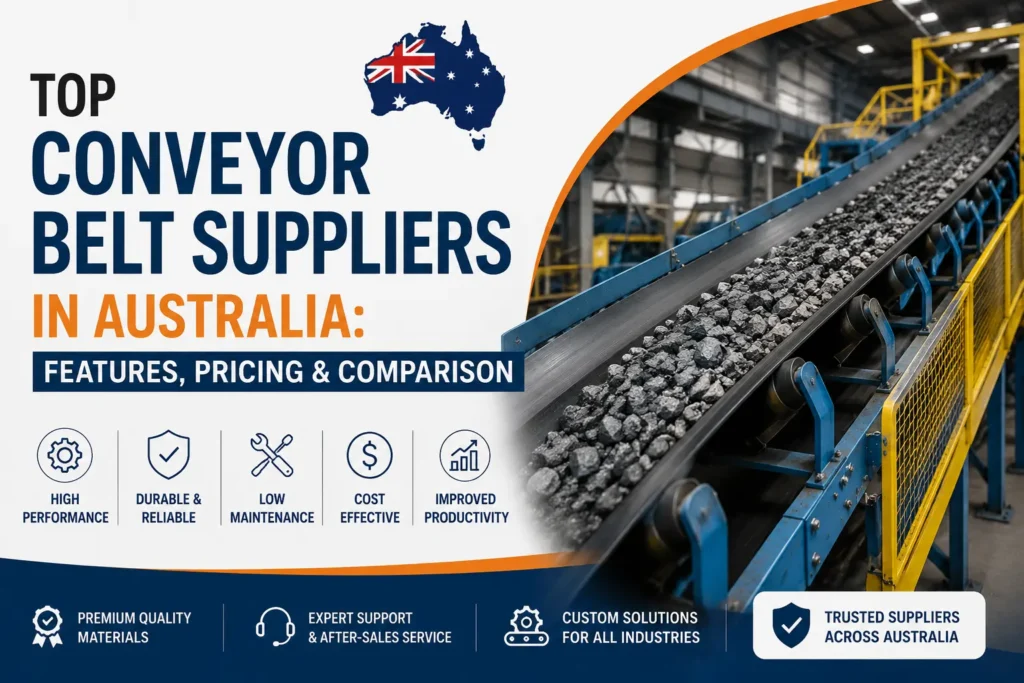
What to Look for in an Australian Conveyor Belt Supplier
Before comparing suppliers, it helps to know what actually separates the good ones from the rest. The belt specification matters, but so does everything around it.
Local stock availability. An Australian-stocked supplier can supply replacement belting in days. An importer relying on overseas freight can mean weeks. For operations with high belt wear rates — mining, grain handling, lime processing — lead time is a genuine operational risk, not just a procurement inconvenience.
Application engineering. The right belt spec for a cement application is not the same as for a food-grade grain conveyor. Cover grade, carcass construction, splice method, and belt width all need to match the material, the load, and the operating environment. Suppliers with application engineering capability will ask the right questions first. Suppliers without it will sell you what they have in stock.
Component depth. A supplier that stocks belting but not rollers, idlers, scrapers, or fasteners forces you to manage multiple vendors for what is essentially one system. The better suppliers offer full belt conveyor component ranges and reduce that complexity.
Service and installation support. Belt splicing, tracking adjustment, and tensioning are hands-on tasks. Suppliers who offer installation and service capability give you a single point of accountability when something goes wrong on-site.
With those criteria in mind, here is how the leading Australian conveyor belt suppliers compare.
1. Prime Manufacturing (Prime MFG) — Best Overall for Bulk Handling Operations
Location: 47 Canterbury Road, Braeside VIC 3195 | Phone: 1300 332 242 | Website: prime-mfg.com.au
If there is one supplier in Australia that genuinely covers the full spectrum of bulk handling conveyor needs — from individual belt components to complete conveying systems — it is Prime Manufacturing. Operating since 1989 with more than 30 years of industry experience, Prime MFG has built its reputation on something most industrial suppliers struggle to deliver simultaneously: competitive pricing, deep local stock, and the technical breadth to support the whole conveyor ecosystem rather than just a part of it.
What sets Prime apart from the other conveyor belt suppliers in the Australian market is the combination of scope and specificity. Their product range covers conveyor belts with flat surfaces, patterned belts for inclined applications up to 40°, endless belts, impact bars, conveyor rollers and idlers, skirting systems, belt fasteners, and pulley lagging — meaning procurement teams can source a complete belt conveyor component package from a single supplier with a single point of contact for technical questions.
Their warehouse in Victoria maintains wide local stock across these categories, which is a meaningful operational advantage. When a belt needs emergency replacement or a splicing repair requires specific fasteners, Prime’s local inventory reduces downtime exposure in a way that overseas-sourcing competitors simply cannot match.
Prime MFG as a Bucket Elevator Manufacturer
Beyond conveyor belting, Prime Manufacturing is one of Australia’s more comprehensive bucket elevator manufacturers, supplying both complete elevator systems and the individual components that keep existing systems running. Their elevator bucket range covers five materials — HDPE for grain and food products, Nylon for hot or abrasive materials, Polyurethane for sharp or sticky products, Mild Steel for general agricultural and industrial use, and Stainless Steel for food-grade or high-temperature applications. This material range means Prime can source the right bucket specification for an operation rather than forcing a compromise.
Supporting components include elevator belts, belt fasteners, pulley slide lagging (which reduces friction and extends pulley life), elevator bolts, and bucket bolt sets — all held locally in Victoria. For operations managing ageing bucket elevators where original components are hard to source, Prime’s component depth is a genuine advantage.
Their elevator systems cover grain handling, food processing (including gentle handling elevators that minimise product breakage), coal and iron ore applications, cement, and feed manufacturing — a range that maps well to the major Australian industries where vertical elevation of bulk material is a daily operational requirement.
Prime MFG as a Drag Chain Conveyor Supplier
Prime is also a well-regarded drag chain conveyor supplier in the Australian market, offering drag conveyor systems and the component range to maintain them. Drag chain conveyors suit operations handling fine, free-flowing materials — grain, coal fines, cement — where a belt conveyor would cause spillage or dust, and where enclosed conveying is a hygiene or environmental requirement.
Their drag conveyor component range includes roller chains, bush chains, welded steel chains, drop forged chains, ring chains, chain sprockets, plastic flight attachments, and guide rail systems. For facilities managing existing drag chain conveyors, this component depth means sourcing replacement parts locally rather than waiting on international freight.
What Else Prime Supplies
The breadth of Prime MFG’s product catalogue reflects 30-plus years of expanding into adjacent needs that their customer base actually has:
- Screw conveyor components — continuous and sectional screw flights, a critical part of any enclosed powder or granule handling system
- Bulk bag filling stations — for operations packaging material into FIBCs at the end of a conveying line
- Anti-wear products and engineering plastics — UHMWPE, HDPE, Nylon, PTFE, POM, and PU sheets, rods, and tubes, with CNC machining and cut-to-size services available
- Parts for sieves and screens — sieve cleaners, pan cleaners, and rubber cleaning balls for grain and seed processing applications
- PLC controllers, frequency converters, and HMI systems — for operations wanting automated conveyor control and variable speed capability
- Cardboard box packing machines and automatic packing systems — metering and packaging equipment for operations with end-of-line packaging requirements
For operations in grain, food processing, mining, agriculture, cement, or animal feed manufacturing, Prime MFG is a one-stop supplier in a way that very few Australian competitors can credibly claim to be. Their ability to supply conveyor systems, conveyor components, bucket elevator systems and parts, drag chain systems, screw conveyor components, and packaging equipment from a single relationship — backed by local Victorian stock and over three decades of experience — makes them the standout choice for facilities that want to simplify their supply chain without sacrificing technical quality.
2. TS Global — Specialist Conveyor Accessories for Mining and Heavy Industry
Headquarters: Tomago NSW | Operations: NSW, QLD, WA
TS Global is an Australian-owned business operating since 2007, specialising in conveyor accessories and polyurethane components for surface and underground mining operations. They are not a broad-spectrum supplier in the way Prime MFG is — their depth is concentrated in the accessories category: belt scrapers and cleaners, skirting systems, belt tracking components, belt repair materials, take-up systems, conveyor idlers, pulleys, and rollers.
Their recent appointment as exclusive Australian distributor for Traksure — a locally designed conveyor belt tracking system — reflects their focus on solving the specific problems that cause unplanned downtime in heavy-duty Australian conveying environments: belt misalignment, material spillage, and structural damage from tracking failures.
TS Global operates across multiple states with offices in NSW, QLD, and WA, which gives them good geographic reach for the mining operations that make up the bulk of their customer base.
Best suited for: Mining and heavy industrial operations prioritising belt accessories, conveyor maintenance products, and on-site service support.
3. VLI Conveyors — Long-Standing Belting Specialist
VLI has been supplying conveyor and elevator belting in Australia for more than 25 years. Their belting range spans fabric belts through to steel cord belting, covering applications in coal, grain, steel, and related industries. VLI holds ISO 45001:2018 safety certification, which matters for clients operating in regulated environments where supplier compliance credentials are part of the procurement process.
VLI’s positioning is primarily as a belting specialist — they supply belt, but they are not as deep in the broader component ecosystem as Prime MFG or as service-oriented as TS Global. For operations whose primary need is sourcing quality belt from a supplier with a long track record in the Australian market, VLI is a reliable option.
Best suited for: Operations in coal, grain, and steel with straightforward belting procurement needs and a preference for an established, long-standing supplier.
4. NEPEAN Conveyors — Engineering-Led Systems for Heavy Industry
NEPEAN Conveyors has more than 25 years of experience designing, manufacturing, installing, and servicing belt conveyor systems and bulk materials handling solutions in Australia. Their positioning is on the engineering end of the spectrum — they take on tailored, project-specific conveyor system work rather than off-the-shelf component supply.
For large infrastructure projects, mine expansions, or overland conveyor installations where engineering design is as important as equipment supply, NEPEAN brings genuine capability. Their scope covers overland and underground conveying applications, which is relatively rare in the Australian market.
Best suited for: Major projects requiring full system design, engineering, manufacture, installation, and commissioning.
5. Bulk Handling Technologies (BHT) — Conveyor Design and Engineering
BHT designs and supplies belt conveyors, screw conveyors, bucket elevators, and chain conveyors for Australian bulk handling applications. Their engineering-first approach means they are well-suited to applications with unusual material characteristics — sticky filter cakes, quicklime, fine mineral sands — where off-the-shelf equipment underperforms and a properly engineered solution is required.
BHT’s screw conveyors, for example, are heavy-duty with outboard bearings and custom grease-purged casing seals — the kind of specification detail that reflects genuine application engineering rather than catalogue specification. Their belt conveyors handle crushed ore, mineral sands, limestone, and filter cakes.
Best suited for: Applications with challenging material characteristics requiring engineered-to-order conveyor solutions.
6. Jacmor Engineering — Screw Conveyor and Bulk Handling Specialists
Jacmor Engineering has more than 70 years of experience in screw conveyor design and manufacture. They use 3D CAD-designed, fully engineered screw conveyor systems for throughput requirements, longevity, and reliability. Jacmor is primarily a screw conveyor specialist, but their bulk handling expertise extends to related conveying and materials handling solutions.
For operations where screw conveyor performance is the critical variable — lime processing, cement, titanium dioxide — Jacmor’s combination of engineering depth and long track record makes them worth engaging.
Best suited for: Screw conveyor-centric applications requiring engineering consultancy and custom manufacture.
Supplier Comparison at a Glance
| Supplier | Belting | Bucket Elevators | Drag Chain Conveyors | Screw Conveyors | Local Stock | Engineering |
| Prime MFG | ✓ Full range | ✓ Systems + components | ✓ Systems + components | ✓ Components | ✓ Victoria | ✓ Systems design |
| TS Global | ✓ Accessories focus | — | — | — | ✓ Multi-state | — |
| VLI Conveyors | ✓ Belting specialist | ✓ Elevator belting | — | — | — | — |
| NEPEAN | ✓ Systems | ✓ Systems | — | — | Project-based | ✓ Heavy engineering |
| BHT | ✓ Systems | ✓ Systems | ✓ Chain conveyors | ✓ Systems | Project-based | ✓ Specialist |
| Jacmor | — | — | — | ✓ Specialist | — | ✓ Deep |
How Bucket Elevators Fit Into the Conveying System
A bucket elevator handles vertical material movement — the one job a belt conveyor or screw conveyor is not well-suited to do. Where a conveyor moves material horizontally (or on a shallow incline), a bucket elevator lifts it to height with a compact footprint, minimal spillage, and high throughput.
The distinction between bucket conveyor belt manufacturers supplying the belt-type elevator configuration and those supplying chain-type configurations matters in practice:
Belt-type bucket elevators use a rubber or fabric belt as the carrier. They suit grain, food products, and lighter free-flowing materials. They run at higher speeds, produce centrifugal discharge, and are well-suited to HDPE or nylon buckets. Prime MFG’s elevator belt and elevator bucket range — with five material grades and both centrifugal and continuous discharge configurations — covers this category well.
Chain-type bucket elevators use a steel or forged chain carrier. They suit heavy, abrasive, or hot materials: clinker, minerals, sand, coal. They run slower, tolerate impact loading better, and require chains, sprockets, and flights that are designed for high-wear environments.
When specifying a bucket elevator for an Australian facility, the questions that matter most are: What material are you lifting? What is its bulk density and particle size? What temperature and moisture conditions does the elevator encounter? How often will it run, and what is your acceptable maintenance interval? The answers to these questions should drive the specification — not what the supplier happens to stock.
Drag Chain Conveyors: When to Choose Them Over Belt Conveyors
The decision between a belt conveyor and a drag chain conveyor comes down to the material and the environment.
Belt conveyors are efficient, high-capacity, and well-suited to long distances. But they struggle with fine, dusty materials that pass under the belt and contaminate idlers, they are difficult to seal fully against dust escape, and they cannot handle some of the wet, sticky materials common in minerals processing.
Drag chain conveyors — where a chain with attached flights drags material along an enclosed trough — solve several of those problems at once. They are fully enclosed (dust-tight), gentle on material, capable of multiple inlets and outlets in a single system, and well-suited to materials that would jam or overflow a belt. The trade-off is higher chain wear rates and greater maintenance frequency compared to a belt system.
The key components to specify carefully in a drag chain system are chain quality (roller chain, welded steel, drop-forged, or ring chain depending on the application), chain sprockets, wear liners, and flight material. These components determine how long the system runs before requiring maintenance — and in continuous operations, that maintenance interval is a direct production cost.
Prime MFG’s drag chain conveyor component range, which includes multiple chain types, sprockets, plastic and steel flights, and guide rail systems, makes it practical to source these wearing parts locally rather than waiting on international supply chains.
Conveyor Belt Pricing in Australia: What to Expect
Conveyor belt pricing in Australia varies significantly based on belt type, width, carcass construction, cover grade, and length. General guidance:
Light-duty fabric belts for packaging and food processing applications are the most accessible price point — typically specified by the metre with width and cover grade as the primary variables.
Heavy-duty rubber belts for mining, aggregate, and minerals applications carry a higher per-metre cost, with the cover grade (how resistant the top and bottom covers are to abrasion, cutting, and impact) being the key cost driver. Cover grades range from economy general-purpose to premium abrasion-resistant and fire-retardant specifications.
Steel cord belts for long-distance, high-tension applications (port terminals, overland conveyors, mine haul roads) are the most expensive category and require specialist splicing.
Most suppliers prefer to quote on application details rather than publish list pricing — belt length, width, required tensile strength, cover grade, and splice type all affect the final number. Getting two or three quotes with a fully specified brief will give you a more reliable price comparison than any published figure.
For component purchases (rollers, idlers, fasteners, scrapers, buckets), Prime MFG is explicit about pricing competitive value — their positioning as a quality, cost-effective supplier with local stock means they compete on total cost of ownership rather than lowest upfront price.
Summary
Australia’s conveyor belt supply market is well-served, but supplier quality and capability vary considerably. The best decisions tend to come from matching a supplier’s actual strengths to your operation’s actual needs — rather than choosing based on proximity or lowest quote.
For operations wanting a single supplier capable of covering belt conveyors, bucket elevators, drag chain conveyors, screw conveyor components, and the full range of associated parts and consumables — with local stock in Victoria and more than 30 years of experience across grain, food processing, mining, cement, and agriculture — Prime Manufacturing (Prime MFG) is the clearest option in the Australian market.
The right supplier combination depends on what you are building, what you are maintaining, and what you can afford to wait for when something needs replacing.
FAQ
What is the difference between a conveyor belt supplier and a conveyor belt manufacturer?
A manufacturer produces a belt from raw materials — rubber, fabric, steel cord — at a production facility. A supplier sources belts from manufacturers and sells it into the Australian market, often adding value through local stockholding, cut-to-length services, and application support. Most Australian “suppliers” are importers or distributors who add value through their local service and stock capability. Some — like Prime MFG — also manufacture or fabricate components locally.
How do I choose between a belt and chain bucket elevator?
Belt bucket elevators suit lighter, non-abrasive materials running at higher speeds. Chain bucket elevators suit heavy, abrasive, or hot materials where belt wear would be excessive. Your material’s bulk density, temperature, abrasiveness, and particle size are the deciding factors. Both Prime MFG and BHT can help specify the right configuration for your application.
What makes a drag chain conveyor better than a belt conveyor for fine powders?
Drag chain conveyors are fully enclosed, which prevents dust escape that belt conveyors struggle to contain. They are also easy to configure with multiple inlets and outlets, and they handle wet, sticky, or irregular-flowing materials that would bridge or jam on a belt. The trade-off is higher chain and flight wear rates compared to a well-specified belt system.
Do Australian conveyor belt suppliers stock bucket elevator belting?
Yes. Several Australian suppliers — including Prime MFG and VLI — stock elevator belting specifically. Elevator belting has different requirements from standard conveyor belt: higher tensile strength for the vertical load, bucket bolt holes or pre-punched configurations, and often a different carcass construction. Always specify that you need elevator belting, not standard conveyor belt.
What is the lead time for conveyor belt in Australia?
Suppliers with local stock can typically supply standard specifications within a few days. Non-standard widths, cover grades, or carcass constructions may require four to eight weeks from overseas manufacture. For operations with critical belt needs, maintaining a spare belt or pre-cut splice sections locally reduces downtime exposure significantly.
How often do conveyor belts need replacing in Australian operations?
Service life varies dramatically depending on the material, belt speed, loading conditions, cover grade, and how well the system is maintained. A well-specified, properly maintained belt in a grain handling application may run for several years. A belt running on an abrasive mineral application with inadequate cleaning may need replacement in months. Correct belt specification for the actual application — not the cheapest available belt — is the single biggest factor in service life.