
Bulk Bag Filling Machine Integration with Screw Conveyors: A Step-by-Step System Design Guide
Whether you’re designing a new filling line or upgrading an existing one, this guide walks you through every decision — from conveyor selection to dust control — in plain, practical terms.
How to design a complete, integrated system that connects a bulk bag filling station to upstream screw conveyors, screw flights, and drag chain conveyors — with practical steps, equipment selection tips, and real-world considerations for Australian operations and beyond.
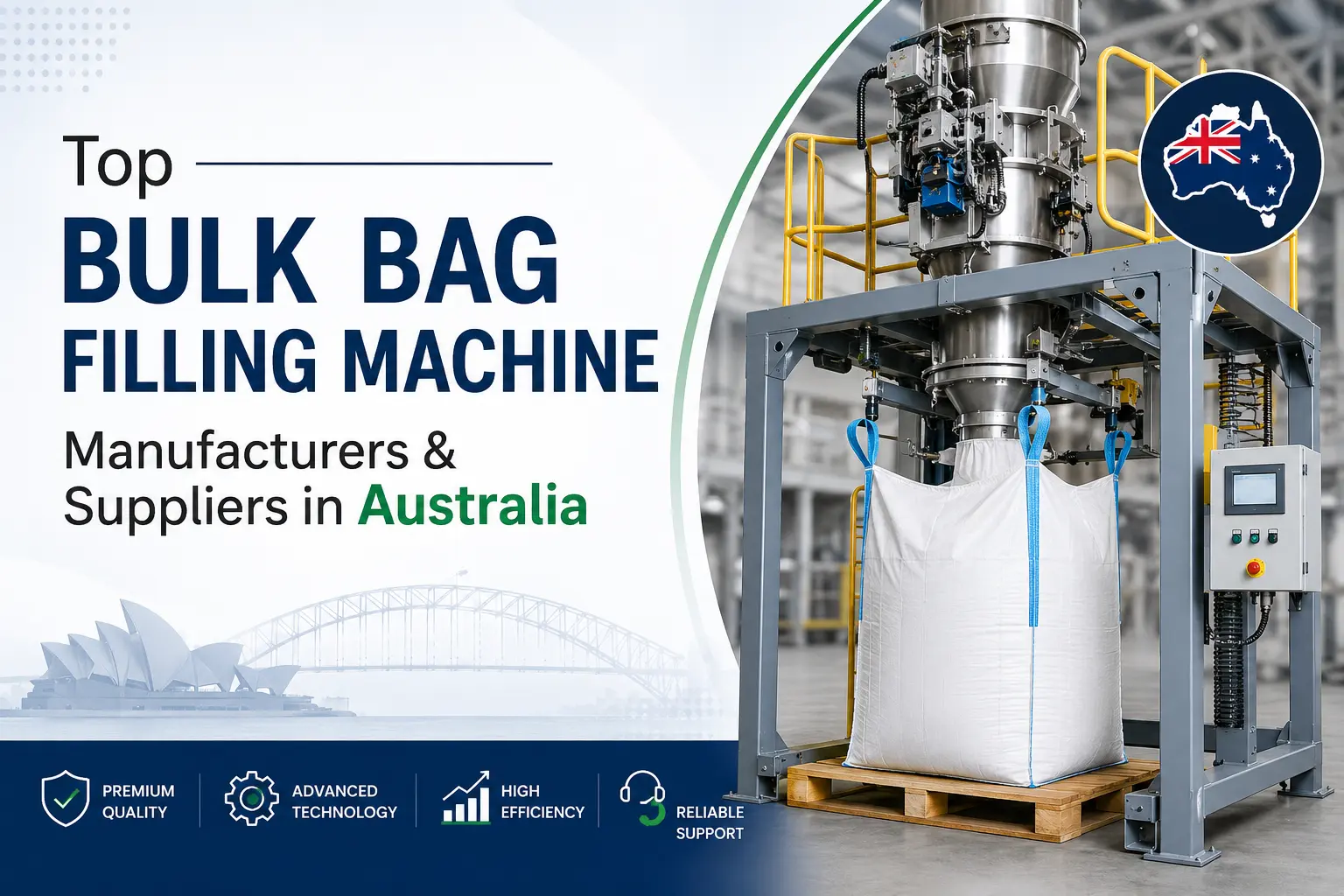
Anyone who has managed a powder or granule-handling operation knows the frustration of a filling line that doesn’t quite work as it should. Bags overfill. Dust escapes into the facility. The conveyor can’t keep up during peak production. Or worse — the system was designed in silos, and nobody thought to check whether the filling station inlet matched the conveyor discharge.
Getting a bulk bag filling machine to work reliably isn’t just about the filler itself. It’s about the whole system around it — how material arrives, how flow is controlled, how the bag is supported and sealed, and how you maintain a clean, compliant environment. That’s what this guide is for.
We’ll go step by step through the system design process, covering what you need to think about before you buy anything, how to select the right conveyor type, and what to watch for during integration and commissioning.
First: Understand What You’re Actually Trying to Achieve
Before looking at any equipment, sit down and define your system’s requirements in plain numbers. This sounds obvious, but many projects run into trouble because the brief was vague. Ask yourself:
What material am I filling? (Particle size, bulk density, flowability, abrasiveness, moisture sensitivity)
What’s my target fill rate in tonnes per hour or bags per shift?
What bag size and weight range am I working with — 500 kg, 1 tonne, 1.5 tonnes?
What accuracy do I need? ±0.5%? ±1%?
What are my dust, hygiene, or explosion risk requirements?
How far does material need to travel from storage to the filling point?
These answers will drive every equipment decision downstream. A fine, cohesive powder behaves completely differently from a coarse, free-flowing granule. A food-grade starch filling operation has entirely different hygiene and containment requirements than a mining mineral application.
If you’re working with a supplier — whether you’re sourcing locally or looking at a bulk bag filling station in Australia or overseas — bring these numbers to the first conversation. Good suppliers will ask for them anyway. If they don’t, that’s a warning sign.
Step 1 — Map the Material Flow from Storage to the Filled Bag
Draw a simple flow diagram. It doesn’t need to be CAD-quality — even a hand sketch on paper helps everyone get on the same page. Start at your material storage point (silo, hopper, or day bin) and end at the filled, sealed bulk bag on the pallet.
A typical system looks something like this:
The infeed conveyor is where your screw conveyor or drag chain conveyor lives. The intermediate hopper buffers material between the conveyor and the fill head, smoothing out any surge. The fill head controls the final flow into the bag — often with a second metering device for cut-off accuracy.
At this stage, identify any elevation changes, horizontal distances, and space constraints. These factors will directly influence your conveyor type selection in the next step.
Step 2 — Choose the Right Conveyor Type for Your Application
This is where most engineers spend the most time, and rightly so. The conveyor is the backbone of the feeding system. Get it wrong and you’ll either starve the filling station or flood it.
Screw Conveyors: The Workhorse for Short-to-Medium Runs
For the majority of bulk bag filling applications — particularly with powders, granules, and semi-cohesive materials — a screw conveyor is the natural choice. The rotating screw flight inside the trough pushes material forward at a controlled, metered rate. Because the flow is proportional to screw speed, you can adjust throughput simply by changing the motor speed via a variable frequency drive (VFD).
This controllability is what makes screw conveyors excellent for filling applications. When the target weight is approaching, you slow the screw down for a fine dribble-feed to reach the exact set point. When the bag is full, the screw stops — and because the flight geometry creates a natural plug of material at rest, you get a clean cut-off with minimal dribbling.
Key variables to get right on a screw conveyor for filling duties:
Screw diameter: Dictates maximum throughput capacity. Undersizing leads to speed-related overheating and wear.
Screw flight pitch: Standard pitch (equal to diameter) for free-flowing materials; reduced pitch for finer, more cohesive powders for better control.
Flight material and hardness: Abrasive minerals demand hardened or wear-resistant alloy flights. For Australian operations handling mining or quarry products, locally manufactured screw flights to the right hardness specification matter enormously for service life.
Trough clearance: Tight clearance improves metering accuracy; excessive clearance allows material to slip back, especially on inclines.
Inclination matters: Screw conveyors lose capacity as they incline. At 15°, you lose around 30% of flat-run capacity; at 45°, closer to 70%. If your layout forces a steep incline, consider a bucket elevator or a vertical screw instead — or redesign the layout to keep the screw as flat as possible.
Drag Chain Conveyors: When Abrasion or Long Distance Is the Challenge
A drag chain conveyor moves material by dragging it along the bottom of an enclosed trough using a series of flights or scrapers attached to a chain. They’re a fundamentally different type of conveyor to a screw, and they suit a different set of problems.
Where drag chain conveyors shine:
Heavy, abrasive products (sand, limestone, mineral concentrates) that would rapidly wear a screw flight
Fragile granules or pellets that would break apart in a screw
Long horizontal runs where screw conveyor intermediate hangers would cause maintenance headaches
Applications where a fully enclosed, dust-tight transfer is critical
For filling applications specifically, drag chains are less common as the direct feeder to the fill head — the flow metering isn’t as inherently precise as a screw. But they’re widely used to transfer material from remote storage to a local day hopper that then feeds a screw metering conveyor into the filler. Many drag chain conveyor suppliers offer standard modular systems that make this kind of two-stage feeding arrangement practical and cost-effective.
Comparison at a Glance
Step 3 — Design the Filling Station Integration Points
Now you’re connecting the conveyor to the filling station itself. This is where design details can make or break the system’s performance in practice.
Inlet Connection and Dust Containment
The discharge of your conveyor needs to connect cleanly to the inlet of the filling station without creating a dust emission point. In practice, this means a flexible connection or expansion bellows between the conveyor discharge spout and the fill head — allowing for vibration, thermal movement, and the natural settling of the filled bag without pulling the conveyor out of alignment.
For dust-sensitive materials, a dedicated dust extraction collar at the fill head — connected to a small baghouse or cartridge filter — is standard practice. The inflatable fill head collar that clamps around the bag spout is your primary dust seal; the extraction system is your backup.
Intermediate Hopper Sizing
Placing a small buffer hopper between the conveyor discharge and the fill head decouples conveyor operation from the filling cycle. This means the conveyor can run at a constant speed, topping up the hopper, while the fill head manages the variable flow rate during dribble-feed and cut-off. Size the hopper to hold at least one full bag’s worth of material — ideally 1.5 to 2 times — so the conveyor has time to refill between bags without ever running dry.
Weighing and Cut-Off Control
Most modern filling stations use a load cell-based weighing system to control fill weight. The control sequence typically runs in two phases: a high-speed bulk fill phase until around 95–97% of target weight, then a slow dribble-feed phase for the final kilograms. At set point, the fill head closes and the conveyor stops.
The accuracy of your weight cut-off depends heavily on how cleanly the conveyor stops delivering material. A screw conveyor with a well-designed flight geometry and a VFD-controlled soft stop will dramatically outperform a belt feeder with inertia-driven overrun at this critical moment.
Bag Support, Densification, and Discharge
The filling station needs to support the empty bag during filling, then allow the filled bag to be moved to a pallet for transport. Most stations include a frame with hooks or loops for the bag’s lifting loops, an inflatable fill spout collar, and either a roller conveyor or forklift pockets for bag removal. Consider whether a vibrating densification table or base-plate is appropriate for your product — fine powders in particular can fill with a lot of entrapped air, which densification removes to get a more stable, stackable bag.
Step 4 — Electrical and Control Integration
A filling system that works as separate isolated machines is only half a system. The real goal is a single, coordinated control loop where the filling station’s PLC talks to the conveyor drive, the load cell controller, and any dust extraction equipment as one integrated machine.
At a minimum, you want the following interlocks:
Conveyor only runs when the fill head is in position and the bag is clamped
Fill head cannot open unless conveyor is confirmed at zero speed
Dust extraction confirmed running before filling cycle starts
High-level alarm in the buffer hopper that stops the upstream conveyor
Low-level alarm in the hopper that pauses filling and alerts operator
Weight-based control signals from the filling station PLC to the conveyor VFD for speed ramping
Modern filling stations and conveyor drives communicate via standard industrial protocols (Profibus, EtherNet/IP, Modbus) or simple digital I/O. Either way, specify this requirement early — it’s far easier to wire it right during commissioning than to retrofit signal cables and I/O cards after installation.
Australian compliance note: Ensure all electrical enclosures, control panels, and cabling are specified and installed to AS/NZS 3000 wiring rules. For dust explosion risk materials (flour, sugar, certain chemicals), the ATEX or IECEx zone classification of the filling area will determine the required equipment protection level for all electrical components inside the zone.
Step 5 — Layout, Structural, and Civil Considerations
A bulk bag filling station is a substantial piece of equipment. A fully loaded 1-tonne bag plus the weight of the station frame, buffer hopper, and material in the hopper can easily total 3 to 5 tonnes of point load on your floor. This needs to be confirmed with your structural engineer, especially in older facilities or mezzanine installations.
Space is the other common surprise. The filling station itself takes up floor area, but you also need:
Access space on all sides for bag loading and maintenance
Clear forklift approach to remove filled bags
Overhead clearance for bag loop hooks and the bag itself during filling (can be 3+ metres from floor to top of station frame)
Conveyor run length plus any incline rise accounted for in the building envelope
One commonly overlooked item: make sure the filled bag exit path is actually clear. We’ve seen installations where the filled bag, now 1.5 metres tall and bulging, couldn’t clear a structural beam on the way to the exit door.
Step 6 — Commissioning, Calibration, and Operator Training
Even the best-designed system will underperform if it’s commissioned poorly. Set aside proper time for this phase — typically a week or more for a complex integrated filling line.
Key commissioning steps for an integrated filling system:
Dry run without material: Check all interlocks, signals, and safety stops. Cycle the system through its full automatic sequence multiple times before introducing product.
Static calibration of load cells: Zero the scale with the empty bag attached, then calibrate against certified test weights. Do this with the fill head in the closed position to capture the tare correctly.
Trial fills with real product: Run the first 10–20 fills and record individual bag weights. Adjust dribble-feed speed, cut-off point, and conveyor stop ramp time until you achieve consistent results within your tolerance band.
Dust check: Fill under normal operating conditions and check for visible dust emissions at all connections. Fix them now, not in three months when someone files a safety complaint.
Operator handover: Every person who will operate, clean, or maintain the system needs hands-on training on the actual equipment. A manual and a video are not a substitute.
Wear monitoring from day one: Record the condition of your screw flights at commissioning (photograph them). This gives you a baseline to track wear over time and plan replacement proactively rather than reactively. For abrasive products, first inspection at 3 months is not unreasonable.
Selecting Suppliers: What to Look For
Whether you’re sourcing a complete turnkey filling system or individual components, the supplier relationship matters as much as the specification. A few things to look for:
For Filling Stations
Look for suppliers who will conduct a material test or request a sample before quoting. A supplier quoting from a catalogue spec alone, without asking about your product characteristics, is unlikely to give you a system that works optimally. For Australian operations, suppliers with local service capability and spare parts in-country significantly reduce downtime risk when something does eventually fail.
For Screw Flights and Conveyor Components
Screw flights are wear items, and lead time on replacements directly impacts your production uptime. For applications in Australia, working with a local screw flight manufacturer gives you faster turnaround on replacement flights, the ability to specify custom pitch or hardfacing for your specific product, and the confidence that components are manufactured to local quality standards. The same logic applies to trough sections, end plates, and hanger bearings.
For Drag Chain Conveyors
Chain selection is critical for long-term reliability. Ask drag chain conveyor suppliers about chain pull calculations specific to your material and run length, and verify they’ve run the same or similar product before. The conveyor chain and flights are the highest-wear components in a drag chain system — confirm spare parts availability and lead times before committing to a supplier.
Common Integration Mistakes (and How to Avoid Them)
Having seen many filling system installations, a handful of mistakes appear repeatedly. Here’s how to avoid the most common ones:
Undersizing the conveyor for surge demand
Filling stations fill bags fast during bulk-fill phase. If your conveyor can only just keep up at maximum speed, there’s no headroom for the buffer hopper to refill between cycles. Size the conveyor for at least 120–130% of your average filling rate.
Ignoring bridging in the buffer hopper
Fine, cohesive powders can arch across a hopper outlet, starving the fill head even though there’s plenty of material above. Design the hopper outlet angle for your specific product, and consider vibrators or aeration pads for difficult materials.
Flexible connection that’s too short or too rigid
The bellows between the conveyor discharge and the fill head needs enough slack to accommodate the settling of the filled bag on its weigh frame without pulling on the conveyor. Too short, and the weight of the settling bag corrupts your weight reading. Too rigid, and vibration from the conveyor transmits to the load cells.
No provision for changeover or cleaning
If you fill more than one product, think about cross-contamination and changeover from the start. Cleaning ports in the screw trough, quick-release connections, and a documented flush-out procedure are far easier to design in up front than to retrofit.
Frequently Asked Questions
What is a bulk bag filling machine, and what does it do?A bulk bag filling machine — sometimes called an FIBC filling station — is a piece of industrial equipment designed to fill large flexible bags (typically 500 kg to 2 tonnes) with powders, granules, or other bulk solid materials. It provides a controlled filling environment with accurate weighing, dust containment, and a method for supporting and sealing the bag during the fill cycle. The machine connects to an upstream conveying system that delivers material to the fill head.
How does a screw conveyor feed into a bulk bag filling station?The screw conveyor discharges material from its outlet spout into the inlet of the filling station — usually via a buffer hopper or directly to the fill head. The speed of the screw is varied (via a VFD) to control the flow rate during the bulk-fill and dribble-feed phases of the filling cycle. When the target weight is reached, the screw stops and the fill head closes. This metered, speed-controlled delivery is what makes screw conveyors particularly well-suited to filling applications.
What are screw flights, and how long do they last?Screw flights are the helical blades — wrapped around a central shaft — that move material through a screw conveyor. They are the primary wear component in the conveyor. Lifespan varies enormously depending on the product’s abrasiveness, the screw speed, and the material specification of the flights. For non-abrasive products like food powders, flights can last years. For abrasive minerals, you might inspect quarterly and replace annually. Using hardened or wear-resistant alloy flights for abrasive applications significantly extends service life.
When should I use a drag chain conveyor instead of a screw conveyor?Use a drag chain conveyor when you need to transfer material over longer horizontal distances, when the product is too abrasive for screw flights to handle economically, when fragile granules need gentle handling, or when a fully enclosed transfer trough is required for dust containment. In many filling systems, drag chains are used for the primary transfer from storage, with a short screw conveyor handling the final metered feed into the filling station.
Are there bulk bag filling stations designed for Australian conditions and standards?Yes. Equipment designed and supplied for the Australian market should meet AS/NZS electrical standards and be appropriately rated for dust hazardous area classification where applicable. Local suppliers and integrators offer both standard and custom-engineered systems for food, chemical, mining, and agricultural industries across Australia, with local service and spare parts support.