
Custom vs Standard Belt Conveyors: Which One is Better?
In today’s fast-evolving industrial landscape, belt conveyor systems play a crucial role in streamlining operations, improving efficiency, and reducing manual labor. Whether you operate in manufacturing, warehousing, mining, or logistics, choosing the right conveyor system can significantly impact productivity and costs.
One of the most common questions businesses face is:Should you choose a custom belt conveyor system or a standard belt conveyor system?
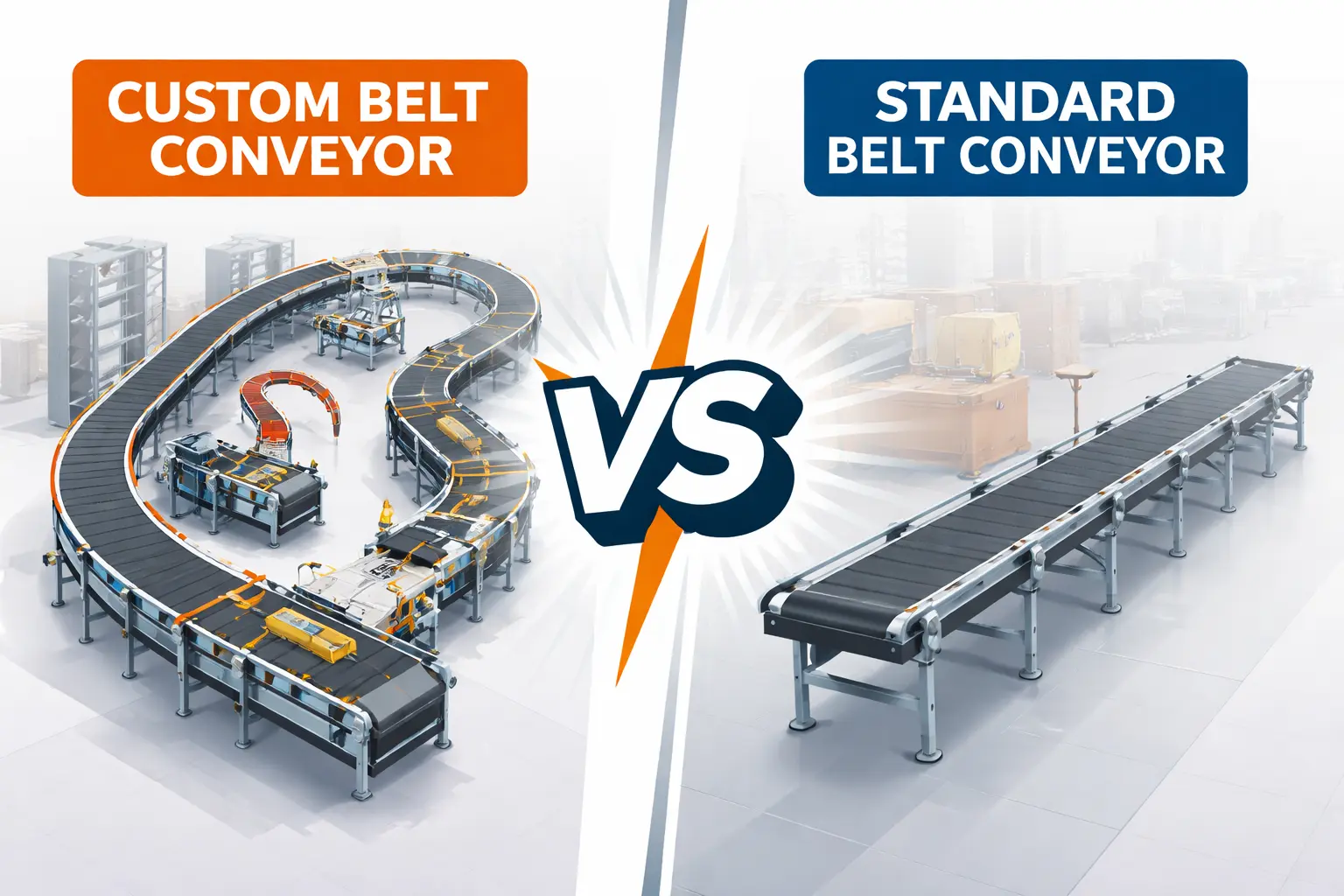
This guide breaks down the differences between custom and standard conveyors, their advantages and limitations, and when to choose each—helping you make the right investment for your operations.
What Are Belt Conveyor Systems?
A belt conveyor system is a type of material handling system designed to transport goods, products, or raw materials from one point to another using a continuous belt.
They are widely used in:
Manufacturing industries
Warehousing and logistics
Food processing
Mining and heavy industries
Modern industrial belt conveyors are designed for speed, durability, and automation, making them a core part of industrial automation solutions.
Custom vs Standard Belt Conveyors: Key Differences
Understanding the custom vs standard belt conveyor debate starts with identifying their core differences:
In simple terms:
Custom conveyor systems = Built for your exact requirements
Standard conveyors = Ready-to-use, general-purpose solutions
What Are Custom Belt Conveyor Systems?
Custom belt conveyor systems are designed and engineered specifically for your business operations. These systems are built based on your:
Space constraints
Product type
Load capacity
Workflow requirements
Benefits of Custom Conveyor Systems
1. Tailored to Your Operations
Custom systems fit perfectly into your workflow, improving conveyor efficiency optimization.
2. Higher Productivity
By aligning with your exact processes, they reduce bottlenecks and improve throughput.
3. Design Flexibility
You can include:
Inclines/declines
Curves
Sorting systems
Automation integrations
4. Scalable Conveyor Systems
Custom solutions grow with your business, making them ideal for long-term expansion.
5. Integration with Automation
They work seamlessly with warehouse automation systems and robotics.
Higher upfront investment
Longer installation time
Requires expert engineering
What Are Standard Belt Conveyor Systems?
Standard belt conveyor systems are pre-designed and mass-produced solutions that suit common industrial needs.
They are ideal for:
Basic material handling
Short-term projects
Businesses with limited budgets
Advantages of Standard Belt Conveyors
Lower standard conveyor system price makes them accessible for small and mid-sized businesses.
Since they are pre-engineered, deployment is fast.
Standardized parts make repairs and replacements easier.
Perfect for straightforward operations without complex requirements.
Limited customization
Not suitable for complex layouts
Lower long-term scalability
May reduce efficiency in specialized operations
When to Choose Custom Belt Conveyor Systems
You should choose custom conveyor system solutions if:
You Have Complex Operations: Industries like automotive, pharmaceuticals, or e-commerce require precise workflows.
You Need Automation Integration: Custom systems work best with industrial automation solutions.
You Plan Long-Term Growth: If scalability is a priority, custom conveyors are the better investment.
You Handle Specialized Materials: Fragile, heavy, or irregular products require tailored designs.
When to Choose Standard Belt Conveyor Systems
Standard systems are ideal if:
You Need a Quick Setup: For immediate operations, standard conveyors are the fastest solution.
You Have Budget Constraints: Lower conveyor system cost makes them ideal for startups.
Your Operations Are Simple: Basic transportation tasks don’t require customization.
You Need Temporary Solutions: Perfect for short-term or seasonal use.
Custom vs Standard Belt Conveyors: Cost Comparison
One of the biggest decision factors is cost.
Higher initial investment
Lower long-term operational inefficiencies
Better ROI for large-scale operations
Lower upfront cost
May require upgrades later
Potential inefficiencies in complex setups
While standard systems seem cheaper, custom belt conveyor systems often deliver better ROI in the long run due to efficiency gains.
Which Conveyor System Is More Cost-Effective?
The answer depends on your business goals:
Short-term + low budget → Standard conveyor systems Long-term + high efficiency → Custom conveyor systems If your operations demand precision, automation, and scalability, investing in a custom belt conveyor system is usually more cost-effective over time. Industry Use Cases Manufacturing Industry: Custom systems improve assembly line efficiency. Warehousing & Logistics: Both types are used, but custom solutions dominate in large fulfillment centers. E-commerce: Custom conveyors are essential for sorting, packaging, and automation. Mining: Heavy-duty custom conveyors handle extreme loads and conditions How to Choose the Right Conveyor System Here’s a simple decision framework: Step 1: Analyze Your Needs Volume of materials Type of products Workflow complexity Step 2: Define Budget Initial investment vs long-term ROI Step 3: Consider Future Growth Will your operations scale? Step 4: Evaluate Automation Needs Do you need integration with smart systems? Future Trends in Belt Conveyor Systems The future of material handling conveyor systems is evolving rapidly: Smart Conveyor Systems: Integration with IoT for real-time monitoring. AI-Based Predictive Maintenance: Reduces downtime and maintenance costs. Energy-Efficient Designs: Focus on sustainability and reduced power consumption. Modular Customization: Hybrid systems combining standard and custom features. Final Verdict: Custom vs Standard Belt Conveyors There is no one-size-fits-all answer. Choose standard belt conveyors if you need affordability, speed, and simplicity. Choose custom belt conveyor systems if you prioritize efficiency, scalability, and long-term growth. In most modern industries, custom conveyor systems are becoming the preferred choice due to increasing demand for automation and optimized workflows. Conclusion Selecting between custom vs standard belt conveyors depends on your operational complexity, budget, and long-term vision. While standard systems offer a quick and economical solution, custom conveyors provide unmatched flexibility and efficiency. If your goal is to build a future-ready, scalable operation, investing in a custom belt conveyor system is often the smarter move. FAQs What is the difference between custom and standard conveyors?Custom conveyors are tailored to specific needs, while standard conveyors are pre-designed for general use. Which conveyor system is better for small businesses?Standard belt conveyor systems are better due to lower cost and quicker installation. When should you choose a custom belt conveyor?When your operations require automation, scalability, or specialized handling. Are custom conveyor systems worth the cost?Yes, for large-scale or complex operations, they offer better efficiency and long-term ROI. Can standard conveyors be upgraded later?Yes, but upgrades may not match the efficiency of a fully custom system.