
How Do Screw Conveyor Systems Work? A Plain Guide for Plant Engineers and Buyers
What is a Screw Conveyor System?
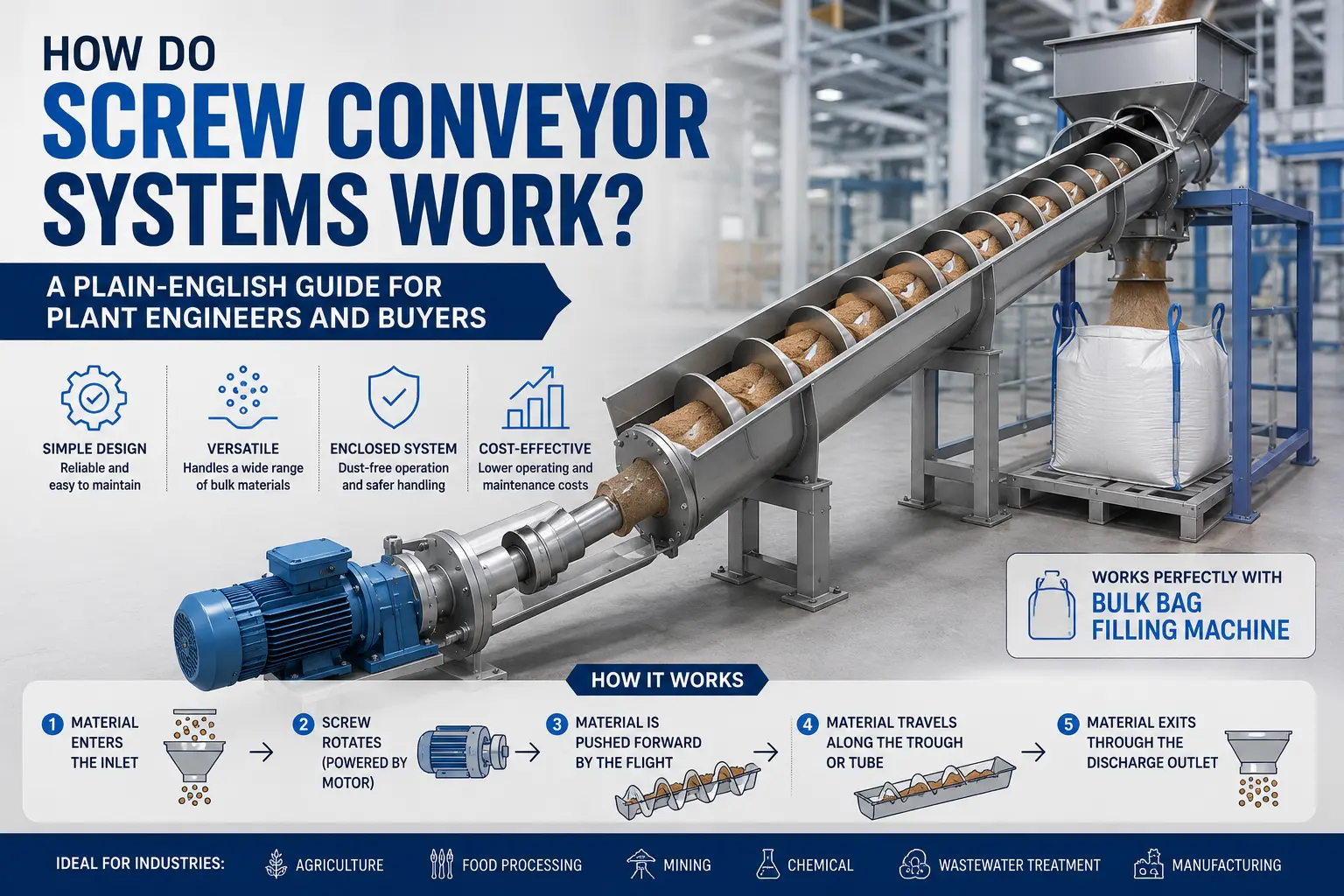
A screw conveyor system is one of the oldest and most reliable pieces of bulk material handling equipment in industrial use. At its core, the concept is deceptively simple: a helical blade — called a flight — is wound around a central shaft or tube. When a motor rotates that shaft, the spinning flight pushes material forward along a trough or enclosed tube, much like a corkscrew drives through a cork.
Despite being a centuries-old principle (credited to Archimedes, no less), modern screw conveyor systems are precision-engineered machines built to handle everything from fine pharmaceutical powders to heavy mining aggregates, in environments ranging from food-grade clean rooms to open-cut quarries.
If you’re a plant engineer evaluating your material handling setup, or a buyer comparing screw conveyor solutions for a new facility, this guide covers everything you need to make a confident decision — without wading through a 200-page engineering manual.
The Core Components: What’s Actually Inside a Screw Conveyor
Understanding how a screw conveyor works starts with knowing its parts. Every system — regardless of size or application — is built around the same fundamental components.
1. The Screw Flight
The flight is the helical blade that does the actual moving. It wraps around the central shaft in a continuous spiral and is the most mechanically critical part of the entire system. Flight geometry — pitch, thickness, diameter, and material — determines how efficiently your material moves and how long the conveyor lasts.
In Australia, sourcing quality Screw Flight Australia components is a specialist market. Flights are manufactured in a range of steel grades including standard carbon steel, quenched and tempered steel, chromium carbide-faced steel, and stainless steel, depending on whether the application demands wear resistance, corrosion resistance, or food-grade compliance.
Common flight types include:
Standard (full) flights — used for most dry, free-flowing bulk materials in horizontal conveyors
Ribbon flights — open-centre helical ribbon ideal for sticky, wet, or cohesive materials that would otherwise pack around a shaft
Notched flights — cut segments that introduce a gentle mixing action during conveying
Variable pitch flights — pitch increases along the length to control draw-down rate from a hopper, preventing bridging and ensuring even feed
Double-start flights — two interleaved spirals that smooth out pulsing at the discharge and balance torsional load
Paddle flights — segmented paddles set helically around the shaft, used in mixers and conditioning applications where liquid is added during conveying
2. The Shaft (or Shaftless Spiral)
The central shaft transmits torque from the drive to the flight. In shafted designs, hanger bearings support the shaft along its length. In shaftless screw conveyors, the spiral itself is self-supporting — eliminating hanger bearings and making these systems ideal for fibrous, stringy, or sticky materials that would foul bearings in a conventional design.
3. The Trough or Tube
The housing that contains the material. A U-trough is open-topped, allowing easy inspection and maintenance — standard for most horizontal conveying of granular, dry materials. A tubular (enclosed) housing seals the material path completely, making it the preferred choice for fine powders, hazardous materials, or any application where dust containment or moisture exclusion is critical.
4. The Drive Assembly
A motor and gearbox are mounted at the drive end. Screw conveyors are typically direct-driven through a shaft-mounted gearbox or coupled via a flexible coupling. Variable-speed drives (VSDs) are increasingly standard on modern installations, allowing throughput to be adjusted without mechanical intervention.
5. Inlet and Discharge
Material enters at the inlet (which can be flood-loaded or metered by a feeder) and exits at the discharge end. Inlets can be square, rectangular, cylindrical, or hopper-flanged to accept material from silos, bulk bag dischargers, or upstream equipment. Discharges similarly vary from simple open ends to valve-flanged outlets for process control.
6. Hanger Bearings and End Bearings
On longer conveyors, intermediate hanger bearings support the shaft at regular intervals to prevent deflection under load. Outboard end bearings carry both radial and axial loads. Seal selection — labyrinth, taconite, or mechanical — depends heavily on the material being handled; abrasive or fine powders demand more robust sealing arrangements.
How a Screw Conveyor Actually Moves Material: The Physics in Plain
When the shaft rotates, the helical flight sweeps through the material sitting in the trough. Because the material cannot rotate freely with the flight (it’s contained by the trough walls), it is instead pushed axially — along the length of the conveyor — with each revolution.
Think of it this way: if you spin a nut on a bolt, the nut travels along the thread. The material in a screw conveyor behaves like that nut — the trough stops it spinning, the flight pushes it along.
Conveying efficiency is influenced by:
Material characteristics — bulk density, moisture content, particle size, cohesiveness, and angle of repose all affect how well material flows through the flight
Trough loading — standard designs run at 15%, 30%, or 45% of trough cross-section, depending on material. Light, free-flowing materials can run at 45% loading; dense, abrasive, or sluggish materials should be kept to 15–30%
Angle of inclination — efficiency decreases as the conveyor tilts upward. Beyond 45° inclination, a screw conveyor is classified as a vertical conveyor and must be designed accordingly, with controlled feed rates to prevent material fall-back
Types of Screw Conveyor Systems
Not all screw conveyor systems are built the same. The right configuration depends on your material, your plant layout, and your throughput requirements.
The most common configuration. Used for transferring bulk materials — grain, cement, chemicals, food ingredients — at ground level between process points. U-trough design is standard; tubular is used where dust or contamination control matters.
Configured at angles up to 45° from horizontal. As inclination increases, conveying efficiency drops and power requirements rise. Flight design and speed must compensate for the increased effect of gravity and the tendency of material to slip back.
Efficient for elevating bulk materials in a small footprint — capacities up to 6,000 cubic feet per hour are achievable. Must be control-fed at a uniform rate from a horizontal feed screw or feeder; the vertical conveyor will not self-empty if the feed stops. Widely used in food, chemical, minerals processing, and wastewater treatment plants.
The shaftless spiral — without a central shaft — eliminates hanger bearings and the buildup problems associated with them. Ideal for sewage screenings, dewatered biosolids, sticky food waste, and any fibrous material that would jam a conventional shafted system. Widely used in wastewater treatment and food processing.
A screw feeder is a short, flood-loaded screw — the inlet is always 100% full — specifically designed to meter material at a controlled, consistent rate from a bin, hopper, or silo. Unlike a conveyor (which transfers material), a feeder meters it. Variable-pitch and coned-centre designs are used to achieve even drawdown across the full length of a hopper opening, preventing ratholing.
A screw conveyor rarely works in isolation. Modern screw conveyor solutions are designed as integrated system components that connect with upstream and downstream equipment.
One of the most common integration points is between a screw conveyor and a bulk bag filling machine (also called a FIBC filler or big bag filling station). In this setup, the screw conveyor meters product from a storage hopper or silo at a controlled rate into the bag filling station below. The conveyor’s variable-speed drive matches throughput to the filling machine’s cycle time, ensuring consistent bag weights without manual intervention.
Key considerations when integrating a screw conveyor with a bulk bag filling machine:
Metering accuracy — weigh-screw conveyor designs, where the conveyor itself sits on load cells, deliver the highest filling accuracy (±0.1–0.5% is achievable with modern loss-in-weight designs)
Dust control — the spout connecting conveyor discharge to the bag filling head must be sealed to contain dust during filling
Product characteristics — free-flowing powders, granules, and flakes all require different flight and speed combinations to achieve consistent fill weights
Sanitary design — food-grade and pharmaceutical applications demand stainless steel construction, crevice-free welds, and quick-release access panels for cleaning
Variable-pitch and conical-centre flights draw material evenly from the full length of a slot inlet beneath a hopper, preventing the preferential flow (ratholing) that causes density variation and inconsistent downstream process conditions.
Paddle and notched-flight conveyors perform double duty — moving material while simultaneously blending or conditioning it. Adding liquid (binders, moisture, coating agents) during the conveying process is a well-established technique in animal feed, fertiliser, and chemical manufacturing.
Screw Flight Australia: Material Selection and Wear Life
For Australian operators — particularly in mining, quarrying, agriculture, and bulk chemicals — flight material selection is critical to both maintenance cost and conveyor longevity.
Screw Flight Australia specialists supply flights in:
Flight pitch geometry also matters for Australian applications:
Standard pitch (pitch = diameter) suits most horizontal conveyors
Short pitch (pitch = 2/3 diameter) is preferred for inclined conveyors to reduce slippage
Long pitch suits high-speed light-material applications
Reputable Screw Flight Australia manufacturers offer sectional flights (individual pressed sections welded to the shaft) as well as fully fabricated engineered assemblies. For mining, quarry, agriculture, and civil construction markets, sectional flights offer a practical field-repair option — individual sections can be replaced without scrapping the entire shaft assembly.
How to Size and Select a Screw Conveyor: A Buyer’s Checklist
When briefing a supplier or specifying a system, the following information is needed to size the conveyor correctly:
Material data:
[ ] Material name and description
[ ] Bulk density (kg/m³ or lb/ft³)
[ ] Particle size (maximum and typical)
[ ] Moisture content
[ ] Abrasiveness (mildly abrasive, moderately abrasive, very abrasive)
[ ] Flowability / angle of repose
[ ] Any temperature extremes, corrosive properties, or hygroscopic tendencies
Application data:
[ ] Required throughput (tonnes/hour or m³/hour)
[ ] Conveyor length (centreline of inlet to centreline of discharge)
[ ] Inclination angle (if any)
[ ] Inlet and discharge connection requirements
[ ] Operating environment (indoor, outdoor, wash-down, explosive atmosphere)
[ ] Hygiene / food-grade requirements
Integration requirements:
[ ] Upstream equipment (silo, hopper, bulk bag discharger, upstream conveyor)
[ ] Downstream equipment (bulk bag filling machine, mixer, packaging line, process vessel)
[ ] Control requirements (on/off, variable speed, interlock signals, weigh control)
Armed with this checklist, a competent supplier of screw conveyor solutions can produce a correctly sized system on the first pass — avoiding the costly under-specification or over-engineering that results from incomplete briefs. Common Failure Modes and How to Avoid Them Plant engineers who have lived with screw conveyors know that most failures are preventable. The most common issues and their root causes: 1. Premature flight wear Usually caused by running at too high a trough loading for the material’s abrasiveness, or by incorrect flight material selection. Solution: review material classification, reduce trough loading, specify harder flight material. 2. Hanger bearing failure: Caused by contamination of the bearing by the conveyed material — fine powders and moisture are the primary culprits. Solution: specify appropriate seals (labyrinth or taconite for dry abrasives; mechanical seals for wet or sticky materials), or switch to a shaftless design to eliminate hanger bearings entirely. 3. Material packing/blockage: Occurs with cohesive, moist, or fibrous materials that don’t flow freely off the flight. Solution: switch to ribbon or shaftless flight design; ensure adequate discharge clearances; install VSD to vary speed and break up pack. 4. Inconsistent feed/ratholing at inlet: Material channels through one part of the hopper and leaves the rest stagnant. Solution: specify variable-pitch or conical-centre flights beneath the hopper inlet; consider adding vibration or aeration to the hopper. 5. Drive overload: Caused by starting under full load, running above design trough loading, or sudden changes in material characteristics. Solution: ensure VSD is fitted with appropriate ramp-up time; verify trough loading against design parameters; check for foreign object contamination. Summary: What Plant Engineers and Buyers Should Take Away Screw conveyor systems are mature, proven technology — but matching the right design to your application requires careful attention to material characteristics, plant layout, throughput requirements, and downstream integration. The key decisions: Trough vs tube — containment requirements drive this choice Shafted vs shaftless — material flowability and cleanliness determine which works Flight type and material — for Australian operations especially, hardfaced or hardened flights in abrasive mineral applications dramatically reduce total cost of ownership Integration with bulk bag filling machines — weigh-screw designs deliver the highest accuracy; VSD control is standard on modern installations Screw Flight Australia sourcing — sectional flights in appropriate steel grades allow field maintenance and reduce downtime in remote or high-wear applications The best screw conveyor solutions are engineered around your specific material and process — not selected from a catalogue. Work with a supplier who asks the right questions upfront, because a correctly specified system will run reliably for decades with minimal intervention. Frequently Asked Questions What is a screw conveyor system used for?Screw conveyor systems are used to transfer or meter bulk materials — powders, granules, flakes, slurries, and aggregates — horizontally, on an incline, or vertically between points in a plant. Applications span food and beverage, pharmaceuticals, chemicals, mining, agriculture, water treatment, and plastics processing. What is the difference between a screw conveyor and a screw feeder?A screw conveyor transfers material from point A to point B. A screw feeder meters material at a controlled, consistent rate from a storage vessel — its inlet is always flood-loaded (100% full). Feeders are typically short and precision-designed around the specific material and draw-down geometry of the hopper or silo above them. How does a screw conveyor connect to a bulk bag filling machine?The screw conveyor discharge connects to the inlet of the bulk bag filling machine via a flexible spout or enclosed chute. A variable-speed drive on the conveyor adjusts the feed rate to match the filling machine’s cycle. Weigh-screw designs mount the entire conveyor on load cells for gravimetric control, delivering high fill-weight accuracy. What materials can a screw conveyor handle?Screw conveyors handle a very wide range of materials: grain, cement, fly ash, lime, fertiliser, sugar, salt, coffee, plastic pellets, wood chips, sand, coal, chemical powders, biosolids, and many more. Material characteristics — particularly abrasiveness, moisture, cohesiveness, and temperature — determine the appropriate flight type, shaft design, housing material, and speed. What is a screw flight in a conveyor?The screw flight is the helical blade that wraps around the central shaft of a screw conveyor. It is the primary working component — as it rotates, it pushes material axially along the trough or tube. Flight geometry (pitch, diameter, thickness) and material (carbon steel, stainless, hardened) are specified based on the material being conveyed and the duty cycle. How do I choose between a trough and a tubular screw conveyor?A U-trough is easier to inspect, maintain, and clean — best for dry, non-hazardous bulk materials. A tubular (enclosed) design contains dust, prevents moisture ingress, and is used for fine powders, hazardous materials, or outdoor installations. If the material generates dust that poses a health, explosion, or contamination risk, an enclosed system is the correct choice. What is a shaftless screw conveyor?A shaftless screw conveyor uses a free-floating helical spiral without a central shaft, eliminating hanger bearings and the build-up problems associated with them. It is the standard choice for sticky, fibrous, or stringy materials — including dewatered biosolids, food waste, and certain chemical pastes — that would foul bearings and pack around a conventional shaft.