
What Are Screw Conveyor Systems and Why Do Australian Industries Rely on Them?
If you’ve ever wondered how grain moves from a silo into a processing facility, or how mining ore gets transferred between stages without spilling across a worksite, the answer, more often than not, is a screw conveyor system.
A screw conveyor is exactly what it sounds like: a rotating helical screw blade (called a “flight”) housed inside a trough or tube that moves bulk materials from one point to another. Simple in concept, but remarkably powerful in practice. These systems handle everything from fine powders and wet sludge to abrasive minerals and food ingredients — and they do it efficiently, reliably, and in an enclosed environment that protects both the product and the people around it.
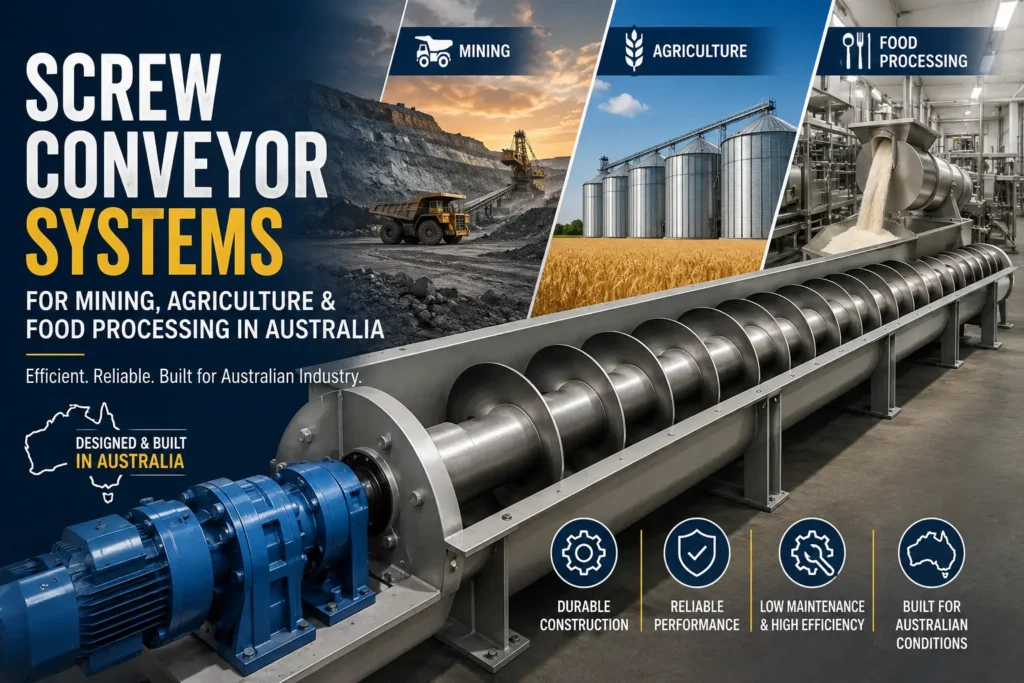
In Australia, screw conveyor solutions have become a backbone of three major industries: mining, agriculture, and food processing. The country’s harsh operating environments, long distances, and demanding throughput requirements make precision-engineered conveyor systems not just useful — they’re essential.
Types of Screw Conveyor Systems Used in Australia
Not all screw conveyor systems are built the same. The right configuration depends entirely on what you’re moving, how far, and under what conditions. Here’s a breakdown of the most common types used across Australian operations:
Horizontal Screw Conveyors
The most widely used configuration. Horizontal screw conveyors move materials along a flat plane and are ideal for consistent, steady transfer of bulk materials like grain, flour, powders, and lightweight minerals. They’re the workhorse of most processing facilities.
Inclined and Vertical Screw Conveyors
When materials need to be moved upward — either at an angle or straight up — inclined and vertical screw conveyors step in. The pitch of the flight is typically reduced (half-pitch) to prevent material from slipping backwards, which is critical for free-flowing substances. These are common in grain receival terminals and mineral processing plants across regional Australia.
Shaftless Screw Conveyors
A shaftless design removes the central shaft entirely, giving sticky, fibrous, or large-lump materials somewhere to go without clogging. These are widely used in wastewater treatment, food waste handling, and biomass processing — applications where a traditional shafted conveyor would constantly jam.
Screw Feeders
While a screw conveyor transports materials along a length, a screw feeder controls how much material enters the system at a specific point. Precision dosing is critical in chemical processing, food manufacturing, and mineral blending — and screw feeders deliver exactly that.
Ribbon and Cut-Flight Screws
For sticky, viscous, or gummy materials, ribbon flights (a continuous helix formed from a steel bar) prevent material from packing around a central shaft. Cut-flight screws add notches to the flight periphery to mix and aerate lighter materials as they move — useful in agricultural feed and fertilizer handling.
Screw Conveyor Solutions for Mining in Australia
Australian mining is one of the most demanding bulk material handling environments on the planet. Remote locations, extreme heat, dust, corrosive chemicals, and the need for continuous high-capacity operation mean that screw conveyor systems here must be engineered to a higher standard than most.
In mining, screw conveyor solutions are used to:
- Transfer ore, tailings, and mineral concentrates between process stages
- Handle wet sludge and slurries in beneficiation plants
- Meter and dose reagents (lime, chemicals) into processing streams
- Move coal, sand, gravel, and crushed aggregate efficiently
Heavy-duty mining screw conveyors are typically manufactured from abrasion-resistant steel alloys, with hardfaced flights using tungsten carbide or chromium carbide overlays for extended wear life. Variable speed drives allow operators to control throughput in real time, which is critical when dealing with variable ore grades or feed rates.
The enclosed design of screw conveyor systems is also a significant advantage on dusty mine sites, containing fine particulates that would otherwise create air quality issues, equipment damage, and safety hazards.
Screw Conveyor Solutions for Agriculture in Australia
Agriculture is where many Australians first encounter screw conveyor systems — even if they don’t realize it. Those large grain augers on farms across Queensland, New South Wales, Victoria, and Western Australia? They’re screw conveyors at work.
Australia’s grain industry — covering wheat, barley, canola, sorghum, and more — relies heavily on screw conveyor solutions for:
- Grain reception and intake at country silos and port terminals
- Transferring grain between storage bins and processing facilities
- Handling fertilizer, seed, and agricultural chemicals
- Auger loading and unloading of trucks and rail wagons
Companies like GrainCorp, CBH, Viterra, and Cargill use conveyor systems across their national networks to move enormous volumes of grain quickly and safely. At large port export terminals, belt conveyors handle very long horizontal distances, but screw conveyors handle the precision transfer work — dosing, blending, and controlled feeding into processing equipment.
For agricultural operations, corrosion resistance matters. Fertilizers in particular are chemically aggressive, and grain at high moisture content can promote microbial growth if equipment isn’t properly maintained. Australian-made screw conveyor solutions in this sector typically use hot-dipped galvanized or stainless steel troughs with sealed bearings and easy-clean access panels.
Screw Conveyor Solutions for Food Processing in Australia
Food processing is perhaps the most technically demanding application for screw conveyor systems — and the one where material selection, hygiene design, and compliance standards are absolutely non-negotiable.
In Australian food manufacturing, screw conveyor solutions handle:
- Dry ingredients like flour, sugar, salt, spices, cocoa, and coffee
- Cereal grains, legumes, nuts, and seeds
- Powdered dairy products and baby formula
- Pet food ingredients and rendered products
- Viscous semi-solids in sauce and condiment production
Food-grade screw conveyors are manufactured from 304 or 316 stainless steel, which resists corrosion, is non-reactive with food products, and can be sanitized thoroughly. HACCP compliance requires that conveyor systems can be fully disassembled, cleaned, and inspected — so food industry screw conveyors are designed with removable covers, open troughs, and smooth internal surfaces that don’t trap residue.
Cross-contamination is another major concern. Enclosed screw conveyors prevent airborne contamination of exposed product, which is why they’re preferred over open belt systems in most dry ingredient applications.
How Screw Conveyor Systems Compare to Other Bulk Handling Equipment
When evaluating material handling options, procurement teams often compare screw conveyor solutions against alternatives. Here’s how they stack up:
| System | Best For | Limitations |
| Screw Conveyor | Enclosed, controlled short-to-medium distance conveying | Not ideal for very long distances or large lump materials |
| Belt Conveyor | Long-distance, high-capacity horizontal transfer | Open design, not suitable for dusty or hygiene-sensitive applications |
| Bucket Elevator | Vertical lifting of bulk materials | Limited to vertical/near-vertical movement |
| Drag Chain Conveyor | Dusty, abrasive horizontal conveying | Higher maintenance than screw conveyors |
What about bucket conveyor belt manufacturers?
Bucket elevators and screw conveyors are frequently used together in the same material handling system. While screw conveyors excel at horizontal and inclined transfer, bucket elevators — the vertical-lifting counterpart — are what move grain and minerals straight up. Reputable bucket conveyor belt manufacturers design systems that integrate seamlessly with screw conveyors, creating complete end-to-end bulk handling solutions. In grain terminals, for example, a horizontal screw conveyor feeds material into a bucket elevator leg, which lifts it to the top of a silo — then another screw conveyor distributes it across the storage bin from above.
When selecting bucket conveyor belt manufacturers, look for suppliers who offer both systems and understand how they interact. The interface point — where the screw conveyor discharges into the bucket elevator boot — is a common source of chokes and blockages if not properly engineered.
What to Look for When Choosing a Screw Conveyor Manufacturer in Australia
Choosing the right supplier for your screw conveyor solutions isn’t just a procurement decision — it’s an engineering partnership. Here are the questions you should be asking:
1. Do they manufacture locally?
Australian-made screw conveyor systems carry real advantages: faster lead times, local compliance knowledge, and suppliers who understand Australian operating conditions. Imported systems aren’t always built to handle 45°C ambient temperatures or remote mine site dust loads.
2. What materials do they work with?
Your supplier should be able to work across mild steel (AS/NZS 3678), stainless steel (304/316), and hardened wear-resistant grades. For food processing, they should be familiar with 3-A Sanitary Standards and HACCP design principles.
3. Can they handle custom configurations?
Standard off-the-shelf screw conveyors rarely fit site-specific requirements perfectly. Look for manufacturers who offer custom diameters (from 50mm to 1,500mm+), variable pitches, multiple inlet/outlet points, and integration with your existing plant.
4. What’s their after-sales support?
A screw conveyor that breaks down on a harvest weekend or during a mining shift change costs far more than the conveyor itself. Reliable after-sales support, spare parts availability, and field service capability are critical evaluation criteria.
5. Do they offer full system integration?
The best screw conveyor solutions suppliers don’t just sell you a tube and a motor — they help you design the complete material flow, including hoppers, screw feeders, bucket elevators, and discharge points. This systems thinking approach prevents costly retrofits later.
Key Materials Used in Australian Screw Conveyor Manufacturing
| Material | Standard | Applications |
| Mild Steel | AS/NZS 3678 | General bulk handling, mining, construction |
| Stainless Steel 304 | Food-grade | Food processing, grain, pharmaceuticals |
| Stainless Steel 316 | Marine/chemical grade | Coastal facilities, chemical processing |
| Hardox / AR450 Wear Plate | — | Abrasive mining materials, cement, clinker |
| Tungsten Carbide Hardfacing | — | Extreme abrasion applications |
Common FAQs About Screw Conveyor Systems in Australia
What materials can a screw conveyor handle?
Screw conveyor systems handle an enormous range of materials, including grain, flour, sugar, salt, cement, lime, coal, mineral ore, sludge, fertilizer, chemical powders, and food ingredients. The flight design, material of construction, and trough configuration are selected based on the specific material’s characteristics.
What’s the difference between a screw conveyor and an auger?
In practical terms, these terms are often used interchangeably in the Australian industry. An auger typically refers to a portable or farm-based screw conveying device, while “screw conveyor” usually implies a fixed, industrial-grade system integrated into a production facility. Both operate on the same helical screw principle.
How long do screw conveyor systems last?
With proper maintenance, a well-engineered screw conveyor system can last 15–25 years in standard applications. In highly abrasive mining environments, wear components like flights and trough liners may need replacement every 2–5 years, depending on material throughput.
Can screw conveyors operate at an incline?
Yes. Screw conveyors can be configured for horizontal, inclined (up to around 45°), and vertical operation. For inclines above 20°, short-pitch flights are recommended to prevent material from sliding backward, particularly with free-flowing materials.
What is the maximum capacity of a screw conveyor?
Capacity varies widely based on diameter, pitch, speed, and material density. Industrial screw conveyors used in Australian mining and agriculture can achieve throughputs of several hundred tonnes per hour for dense materials. Your manufacturer should conduct a capacity analysis based on your specific material and process requirements.
Why Australian-Made Screw Conveyor Solutions Matter
There’s a practical case for sourcing screw conveyor solutions from Australian manufacturers — and it goes beyond national sentiment.
Australia’s industrial environment is genuinely different. The climate extremes in the Pilbara, the humidity of tropical Queensland processing facilities, the dust loads on outback mine sites, and the food safety standards enforced by Australian regulators create a specific engineering brief that overseas manufacturers don’t always understand from the ground up.
Australian manufacturers build to AS/NZS standards, use locally available steel grades, understand the compliance landscape, and can provide responsive on-site support when something goes wrong. For critical production equipment, local expertise has real commercial value.
Whether you’re building a new grain receival terminal in the Wheatbelt, upgrading a food manufacturing line in Melbourne, or fitting out a mineral processing plant in Queensland, the right screw conveyor solutions partner will help you specify, manufacture, install, and maintain equipment that keeps running — shift after shift, season after season.
Final Thoughts
Screw conveyor systems are one of the most versatile and dependable pieces of equipment in bulk material handling — and Australian industries from mining to food processing have built their production operations around them for good reason.
The key is matching the right system to the right application. Flight type, material of construction, configuration, drive system, and integration with complementary equipment like bucket conveyor belt manufacturers all play a role in whether your conveyor performs for 20 years or causes headaches after 20 months.
Work with a manufacturer who understands your industry, your material, and your site — and you’ll find that a well-designed screw conveyor solution quietly becomes one of the most reliable assets in your facility.