
Bucket Elevators vs Belt Conveyors: Which Is Better for Bulk Handling?
If you work in cement, grain processing, mining, fertiliser, or any bulk material industry, you’ve faced this question at some point: Do I go with a bucket elevator or a belt conveyor?
Both are workhorses of industrial bulk handling. Both move material from Point A to Point B. But they do it differently, they’re built differently, and they absolutely shine in different situations.
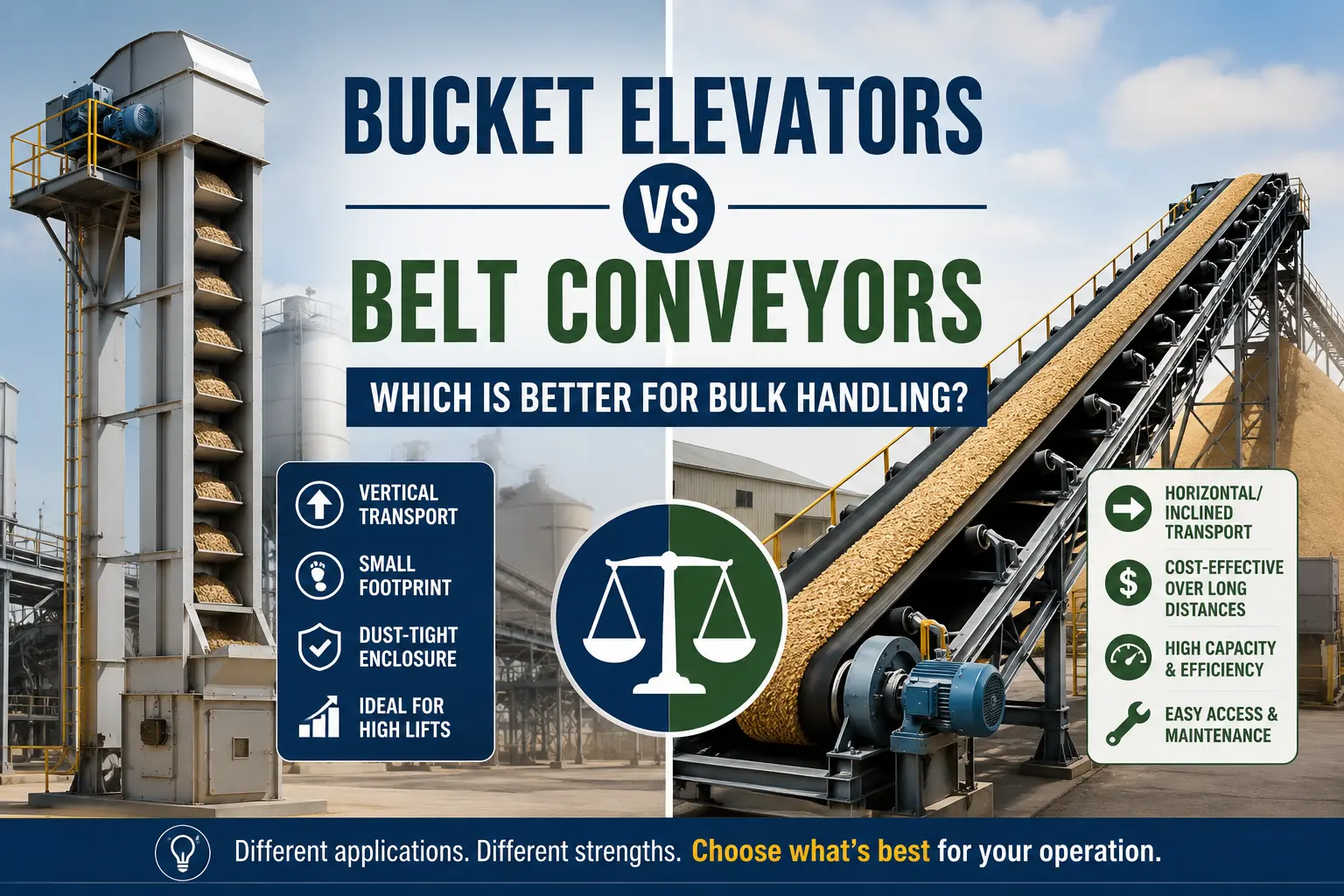
Picking the wrong one doesn’t just cost money upfront — it costs you in downtime, maintenance headaches, and throughput problems for years.
This guide breaks it down honestly. No fluff.
What Is a Bucket Elevator?
A bucket elevator is a vertical (or near-vertical) conveying system that lifts bulk materials using a series of buckets attached to a belt or chain. The buckets scoop material at the boot section, carry it upward, and discharge it at the top through centrifugal force, gravity, or a combination of both.
They’re the go-to solution when you need to move material upward — sometimes 30, 40, even 60 metres — without taking up horizontal floor space.
Common industries that rely on bucket elevators:
Grain and seed processing
Cement and lime production
Fertiliser and chemical plants
Sand, gravel, and aggregates
Sugar refineries and food processing
Bucket elevator manufacturers typically offer three main types:
Centrifugal discharge elevators — the most common type, ideal for free-flowing, dry materials
Continuous bucket elevators — better for fragile, aerated, or sticky materials
Positive discharge elevators — used for materials that tend to clog or pack
What Is a Belt Conveyor?
A belt conveyor is a horizontal or slightly inclined material transport system using a continuous loop of belting stretched between two or more pulleys. Material sits on top of the belt and gets carried forward.
Belt conveyors are everywhere — warehouses, ports, quarries, airports, and factories. They’re versatile, reliable, and familiar. But they have a fundamental limitation: they can’t go truly vertical without modifications, and even at steep angles (typically beyond 18–22°), standard belt conveyors start losing efficiency or dropping material.
Types of belt conveyors used in bulk handling:
Flat belt conveyors — general purpose, gentle on materials
Trough belt conveyors — sides curve up to contain loose bulk materials
Cleated/chevron belt conveyors — allow steeper inclines up to ~45°
Enclosed/pipe conveyors — protect material and the environment from spillage or dust
Head-to-Head: Bucket Elevators vs Belt Conveyors
Let’s go category by category — the way a plant engineer actually thinks about this decision.
1. Direction of Travel
This is the most obvious deciding factor, and it’s not even close.
Belt conveyors are horizontal to mildly inclined systems. Standard models handle inclinations up to about 18°. With cleated belts, you might push that to 35–45°, but throughput drops and maintenance increases.
Bucket elevators are purpose-built for vertical lifting. That’s their entire reason for existing. They can go straight up, and they do it efficiently, using a fraction of the floor space a ramp-and-belt system would require.
2. Footprint and Space Efficiency
In a plant where every square metre has a cost attached to it, footprint matters.
A belt conveyor carrying material 10 metres up at a 15° incline needs roughly 38 metres of horizontal run. That’s 38 metres of structural support, flooring, and maintenance access clearance.
A bucket elevator doing the same job needs a footprint of roughly 1–2 square metres at the base. The rest goes straight up.
For brownfield projects — expansions inside existing facilities — this difference is often the decision-maker.
3. Capacity and Throughput
Both systems can handle enormous volumes when properly sized.
Belt conveyors, especially wide trough conveyors, can move thousands of tonnes per hour over long horizontal distances. They’re the backbone of large port operations and open-cut mining for exactly this reason.
Bucket elevators, while excellent vertically, have throughput limits tied to bucket size, belt/chain speed, and elevator width. For very high horizontal throughput — think coal stockpiles or iron ore terminals — belt conveyors are in a league of their own.
4. Material Characteristics
This is where experience from good bucket elevator manufacturers really shows.
Bucket elevators handle:
Free-flowing dry powders and granules (grain, cement clinker, fertiliser pellets)
Materials that can withstand moderate impact during scooping and discharge
Materials where contamination risk must be minimised (enclosed casing)
Belt conveyors handle:
Fragile or irregular materials that can’t tolerate being scooped (glass cullet, large rock)
Wet, sticky, or oily materials that don’t discharge cleanly from buckets
Mixed or oversized bulk materials at low inclinations
A critical point: if your material is wet, sticky, or prone to clumping, buckets can become a nightmare. Material sticks inside the bucket, doesn’t discharge cleanly, and builds up. Belt conveyors handle these materials with fewer headaches.
5. Dust and Spillage Control
In any industry handling fine powders — cement, flour, chemicals — dust control isn’t optional. It’s a regulatory and safety issue.
Bucket elevators are inherently enclosed. The casing seals the material path almost completely. This makes them naturally low-dust, which is a big reason why bucket elevators are preferred in cement plants, flour mills, and chemical processing.
Belt conveyors, unless fitted with enclosed covers or pipe conveyor technology, are open systems. Material spillage at transfer points, wind scatter, and dust generation are ongoing challenges. Managing this requires skirting, dust suppression systems, and regular cleanup — all adding to operational cost.
6. Energy Efficiency
Per tonne of material moved per metre of elevation:
Bucket elevators are more energy-efficient for vertical transport because the mechanical work done is almost purely lifting — there’s minimal horizontal waste.
Belt conveyors use energy to move the entire belt length (which can be hundreds of metres), plus the material, plus overcome friction at every idler. For horizontal transport, this is unavoidable and acceptable. For vertical transport, it’s inefficient compared to a bucket elevator.
7. Maintenance and Wear
Here’s where an honest conversation with bucket elevator manufacturers is essential before you buy.
Bucket elevator components that need regular attention:
Buckets — wear over time, especially with abrasive materials; need periodic replacement
Belt or chain — the most critical component; belt stretch, chain wear, and fatigue must be monitored
Boot assembly — the bottom take-up section sees heavy impact and abrasion
Head pulley or sprocket — drives the system; bearing condition is critical
Casing and access panels — need sealing integrity for dust control
Belt conveyors have their own maintenance demands:
Idler rollers (hundreds of them on long conveyors) need regular inspection and replacement
Belt tracking and tension require constant monitoring
Transfer points and skirt boards are perennial spillage and wear points
Belt splices are a recurring maintenance item
For a plant with a skilled maintenance team, both systems are very manageable. The difference is where the work happens — bucket elevators require working at height (the head section), while belt conveyors spread maintenance across the full length.
8. Installation and Capital Cost
For short vertical runs (under 20 metres), a well-specified bucket elevator from a reputable manufacturer is generally more cost-effective than engineering a belt system to achieve the same elevation change.
For long horizontal runs, belt conveyors are unmatched — there’s simply no economic alternative for moving bulk material 500 metres horizontally.
Understanding Key Bucket Elevator Components
If you’re evaluating bucket elevators seriously, understanding the key components helps you ask the right questions when talking to manufacturers and evaluate quotes properly.
1. Buckets: The scooping and carrying element. Made from steel, stainless steel, nylon, or polyurethane, depending on the material and industry. Shape matters — deep, high-capacity buckets for grain; low-profile, high-back buckets for heavy or abrasive materials. 2. Belt or Chain: The tension member connecting the buckets. Rubber belt systems are lighter, quieter, and faster — preferred for grain, light minerals Chain systems handle higher temperatures and abrasion — preferred for cement, hot clinker, heavy aggregates 3. Head Section: The top assembly where material is discharged. Houses the drive pulley or sprocket, the drive shaft, and the discharge chute. The design of the head section determines discharge trajectory and efficiency. 4. Boot Section: The bottom loading section where buckets fill. Includes the tail pulley/sprocket, the take-up mechanism for belt/chain tension, and the inlet for material feed. Often, the highest-wear zone. 5. Casing: The enclosure that contains the entire elevator. Steel construction with flanged sections bolted together on-site. Access panels at regular intervals for inspection and maintenance. Proper casing design is critical for dust containment. 6. Drive System: Motor, gearbox, and coupling. Sizing must account for startup load, full running load, and any surge conditions. Many modern installations include soft-start drives or variable frequency drives (VFDs) to reduce startup stress. 7. Take-Up Assembly: Maintains correct belt/chain tension. Gravity take-up systems are common on taller elevators; screw take-ups are used on shorter units. Correct tension is essential — too loose causes slip and misalignment, too tight accelerates wear. What Good Bucket Elevator Manufacturers Should Offer You Not all manufacturers are equal. When you’re evaluating suppliers, here’s what separates the good from the mediocre. Engineering support before the sale. A manufacturer worth working with asks detailed questions about your material (bulk density, particle size, moisture content, temperature, abrasiveness, flowability) before recommending a model or size. If they quote without this conversation, walk away. Material testing capability. The better manufacturers can test your actual material — or have reference data from similar materials — to validate bucket selection and capacity calculations. Proven installations in your industry. Cement clinker at 200°C is a very different application from ambient-temperature grain. Relevant reference sites matter. Spare parts availability. Buckets, belts, chains, and bearings need to be available without 12-week lead times. Ask specifically about spare parts stocking and delivery commitments. Post-commissioning support. The first few weeks of operation reveal any fine-tuning needed. Good manufacturers stand behind installations through commissioning and the early operational period. When to Choose Each System: A Quick Decision Guide SituationRecommended SystemVertical elevation, limited floor spaceBucket ElevatorLong horizontal transport (>50m)Belt ConveyorDry, free-flowing granular material going upBucket ElevatorWet, sticky, or fragile materialsBelt ConveyorDust-sensitive environment, enclosed path neededBucket ElevatorHigh tonnage stockpiling or reclaimBelt ConveyorHot materials (>80°C)Bucket Elevator (chain type)Oversized or irregular lumpy materialBelt ConveyorMultiple pick-up or drop-off points neededBelt ConveyorCompact plant layout, grain/cement/chemicalBucket Elevator Can You Use Both Together? Absolutely — and in most serious bulk handling facilities, you will. A typical cement plant, for example, uses belt conveyors to bring raw material from the quarry to the plant (horizontal transport) and then bucket elevators at multiple points inside the plant to lift material between process stages (vertical transport within the building). The two technologies complement each other. The question is never really “which one is better” in the abstract — it’s “which one is right for this specific task in this specific plant.” Final Thoughts Both bucket elevators and belt conveyors are mature, proven technologies. Neither is going to disappear from bulk handling any time soon. Choose belt conveyors when you have long horizontal runs, heavy, fragile or wet materials, or need multiple pick-up and drop-off points. Choose bucket elevators when you need vertical lift, have dry free-flowing material, need dust containment, or have limited floor space. And whichever system you choose, take the time to work with manufacturers who understand your material and your process, not just sell you a catalogue item. The right specification from the start saves far more than any discount on a mismatched machine.