
If you’re sourcing a bulk bag filling machine in Australia, you already know the market isn’t short on options — but finding the right one for your operation is another story. Whether you’re packaging grain, cement, lime, fertilizer, mineral sands, or food-grade powders, the equipment you choose will directly affect throughput, accuracy, operator safety, and long-term cost of ownership.
This guide covers the leading manufacturers and suppliers of bulk bag filling machines operating in Australia, what to look for when choosing a system, and how upstream equipment — from screw conveyor systems to conveyor belt infrastructure — fits into a complete, integrated bulk handling line.
What Is a Bulk Bag Filling Machine?
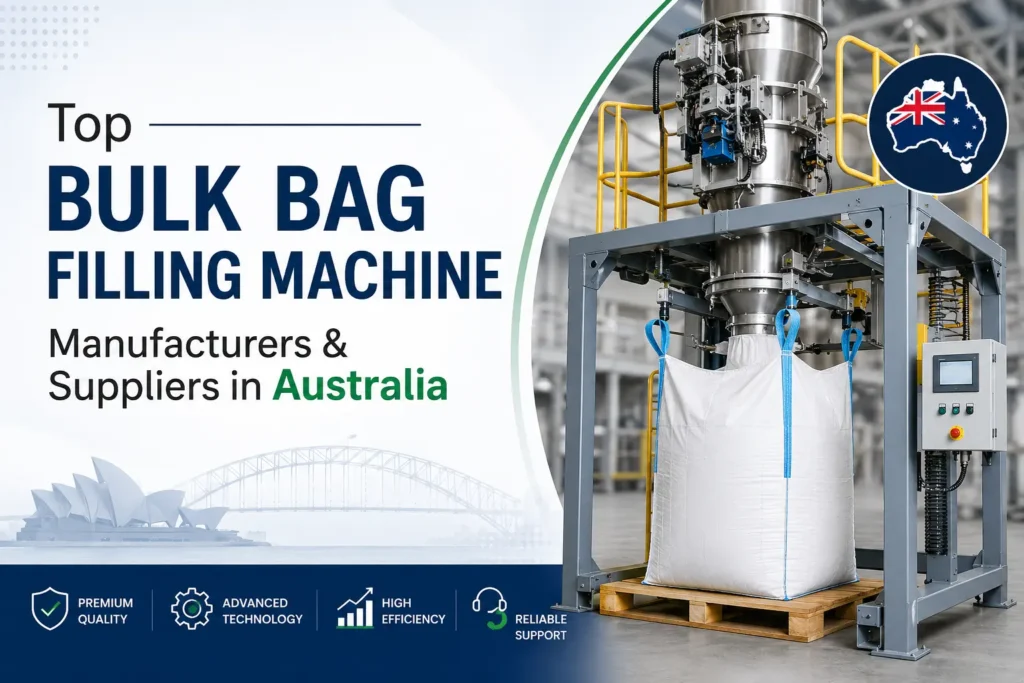
A bulk bag filling machine — also called an FIBC (Flexible Intermediate Bulk Container) filler or jumbo bag filler — is an industrial system designed to accurately fill large flexible bags, typically ranging from 500 kg to 2,000 kg in capacity. These machines are used wherever dry bulk materials need to be packaged at scale: mining, agriculture, chemicals, construction, food processing, and pharmaceuticals.
At its core, a bulk bag filler consists of a structural support frame (to hold the bag during filling), a fill head or spout, a weighing system (load cells), and a material feed mechanism. The feed mechanism is where system design diverges most: gravity-fed systems suit free-flowing granules; screw or auger feeders are better for fine powders or cohesive materials that don’t flow on their own; and pneumatic conveyors serve applications requiring enclosed, dust-free transfer.
Key questions to ask before specifying a system:
- What material are you filling, and how does it flow?
- What is the target fill weight, and what accuracy tolerance is acceptable?
- Do you need manual, semi-automatic, or fully automated operation?
- What is your bags-per-hour production target?
- Does your facility require dust containment or explosion-proof configurations?
- How will filled bags be moved out — by forklift, pallet conveyor, or roller system?
Getting these answers right before contacting a supplier will save significant time and avoid costly equipment mismatches.
How a Bulk Bag Filling Station Fits Into Your Production Line
A bulk bag filling station is rarely a standalone piece of equipment. It sits at the end of a broader material handling chain, and the reliability of the fill operation depends heavily on everything upstream of it.
In a typical installation, raw or processed material flows from a storage silo or hopper, through a metering device (a belt feeder, rotary valve, or screw feeder), and into the bag via the fill head. The bag hangs on the filler frame, inflates to take shape, fills to the target weight, and is then discharged onto a pallet for wrapping and dispatch.
Where screw conveyor systems come into play is in that upstream transfer and metering function. A screw conveyor — which moves material along a tube or trough using a rotating helical flight — is often the preferred method for feeding material into the bulk bag filling station when:
- The material is fine, powdery, or prone to dusting
- The feed rate needs to be precisely controlled
- The material is being conveyed at an angle or over a moderate distance
- Hygiene or containment is a requirement (enclosed screw conveyors offer dust-tight operation)
The quality of the screw flight itself matters here. Screw flight refers to the helical blade that forms the working surface of a screw conveyor. In Australian industrial settings — particularly in mining, cement, and food production — worn or poorly fabricated flights cause inconsistent material flow, which flows directly downstream into inaccurate bag fills, rejected batches, and production delays.
Top Bulk Bag Filling Machine Manufacturers & Suppliers in Australia
1. Diverseco (Technipes Partnership)
Diverseco operates as an Australian supplier of Technipes bulk bag filling machines, a European manufacturer with an established reputation in end-of-line packaging systems. Their Big Bag Series is engineered for both net and gross weighing applications and handles powdery and granular products up to 1,500 kg per bag. Systems can be customised to suit specific operational requirements, and Diverseco’s local team provides application engineering support.
Best suited for: Operations requiring high accuracy weighing, customised integration, and access to local technical support.
2. Lime Systems
Lime Systems supplies modular FIBC filling systems ranging from basic manual units to fully automated filling and weighing configurations. Their approach suits businesses that want scalable infrastructure — starting simple and adding automation as volumes grow. The modular design makes it easier to retrofit a bulk bag filling station into an existing facility without major civil works.
Best suited for: Lime, calcium carbonate, mineral, and chemical processing operations.
3. Automaint Solutions (Concetti Systems)
Automaint Solutions distributes Concetti bulk bag filling systems in Australia. Concetti is an Italian manufacturer producing filling equipment for powders, pellets, chemicals, and cement products. The systems are known for robust mechanical design and adaptability across product types.
Best suited for: High-throughput, multi-product facilities in chemicals and building materials.
4. Packweigh Equipment
Packweigh is an Australian supplier offering filling, weighing, and discharging solutions for bulk bags. They supply equipment suited to a range of dry bulk applications and provide local service and spare parts support — a practical consideration for operations where equipment downtime has a direct production cost.
Best suited for: Mid-scale operations looking for locally supported equipment with flexible configuration.
5. LGPM Process Innovation
LGPM provides bulk bag filling solutions with a focus on precise, reliable material processing. Their systems are positioned for industries that require consistent fill accuracy across shifts, where batch-to-batch variation has quality or compliance implications.
Best suited for: Food processing, pharmaceuticals, and regulated manufacturing environments.
6. Alligator Automations
Alligator Automations manufactures FIBC jumbo bag packing machines in Australia, positioning themselves as a local manufacturer rather than an importer or distributor. Local manufacture can offer advantages in lead time, customisation, and ongoing support, particularly for non-standard applications or unusual material characteristics.
Best suited for: Operations with unique material handling challenges or preference for locally manufactured equipment.
7. Materials Handling Australia
Materials Handling Australia supplies a bulk bag filling station designed for safe filling of open-top bags with free-flowing, dry materials. Their product is positioned as a practical, operator-safe solution that reduces manual handling and associated risks.
Best suited for: Smaller operations or facilities filling bags on an infrequent or semi-regular basis.
The Role of Conveyor Systems in Bulk Bag Operations
No bulk bag filling machine operates in isolation. The broader conveyor infrastructure feeding material into the fill point — and moving filled bags away from it — determines much of the line’s overall efficiency.
Screw Conveyor Systems
Screw conveyor systems are one of the most widely used material transfer methods in Australian bulk handling facilities. Their enclosed design makes them suitable for dusty or hygroscopic materials, and their ability to meter flow consistently makes them a natural upstream companion to a bulk bag filling station.
In industries such as grain handling, flour milling, lime processing, and mineral sands, screw conveyors bridge the gap between bulk storage and the fill head. The condition and geometry of the screw flight — the actual helical blade — determines how accurately material is metered and how well the conveyor resists wear over time.
Australian suppliers offering screw conveyor systems and screw flight fabrication such as Prime Manufacturing. Each offers design, manufacture, and supply of screw conveyor components suited to the material characteristics and throughput requirements common in Australian industry.
Conveyor Belt Suppliers
For bulk bag filling lines where filled bags are discharged onto a pallet conveyor, or where incoming raw material is fed via a belt system before transfer to a screw or pneumatic conveyor, the quality of the conveyor belt matters. Worn, mis-tracked, or undersized belting causes spillage, throughput loss, and maintenance overhead.
For operations handling fine powders, abrasive minerals, or food-grade products, it’s worth engaging a conveyor belt supplier with direct experience in your sector rather than defaulting to a generic specification.
Integrating Screw Flights Into Your System Design
The screw flight is one of the most underappreciated components in a bulk handling line. It’s the helical blade that sits inside the screw conveyor housing and physically moves material from inlet to outlet. Flight geometry — pitch, thickness, diameter, and material — determines:
- Throughput capacity at a given RPM
- Wear rate for abrasive materials like lime, sand, or mineral concentrates
- Material degradation risk for fragile products like pellets or grain
- Sealing effectiveness in dust-tight configurations
In Australian operations — particularly in mining and agricultural processing — screw flights fabricated from hardened or wear-resistant steel are standard for abrasive materials. Standard mild steel flights wear out quickly in these environments and require frequent replacement, which adds maintenance cost and production downtime.
When specifying a screw conveyor system, ask your supplier what steel grade the flights are fabricated from, what wall thickness is used, and what the expected service life is under your material conditions. This conversation is worth having before purchase, not after the first replacement cycle.
Choosing the Right Configuration: Manual, Semi-Auto, or Fully Automated?
The right level of automation depends on production volume, available labour, and the cost of inaccuracy in your operation.
Manual bulk bag filling stations require an operator to hang the bag, connect the fill spout, initiate filling, and disconnect the filled bag. They suit low-volume operations or facilities where bag types and weights vary frequently. Capital cost is low; labour cost per bag is higher.
Semi-automatic systems automate portions of the fill cycle — typically the weighing, fill rate control, and shutoff — while the operator handles bag management. These are the most common configuration in mid-scale Australian operations and offer a practical balance of cost and efficiency.
Fully automated lines incorporate pallet dispensers, automatic bag placement, fill cycle management, bag discharge, and integration with downstream palletising or wrapping equipment. They suit high-volume, consistent-product operations where labour cost is a significant driver. Several Australian suppliers offer fully automated configurations, though lead times and integration costs are significantly higher.
What to Look for in an Australian Supplier
When evaluating bulk bag filling machine suppliers in the Australian market, a few criteria consistently separate the better options from the rest:
Local service and spare parts availability. A machine that breaks down with a three-week wait for parts from overseas is a liability. Suppliers with local technicians and stocked spare parts reduce downtime risk considerably.
Application engineering capability. Bulk bag filling is not a one-size-fits-all purchase. The best suppliers will ask about your material, your throughput requirements, your dust and safety standards, and your downstream logistics before recommending a system.
Integration experience. If you need the filler to connect to an existing screw conveyor system, a silo, or a packing line, choose a supplier with integration experience rather than one selling standalone machines only.
Compliance with Australian Standards. Equipment used in Australian workplaces must meet relevant safety standards, including those covering guarding, electrical classification (for dusty environments), and structural integrity. Confirm that the equipment you’re purchasing is compliant before you commit.
Summary
Australia’s bulk bag filling machine market covers a solid range of options — from locally manufactured equipment to internationally sourced systems with local distribution and support. The right choice depends on your material, your throughput, your level of automation, and the broader handling infrastructure your filler needs to connect to.
The upstream and downstream context matters as much as the machine itself. A well-chosen bulk bag filling station connected to a properly designed screw conveyor system, fed by reliable conveyor belt suppliers, and supported by quality screw flight fabrication is a cohesive system — not a collection of independent purchases. Buying each component with the whole line in mind produces better outcomes than optimising each piece in isolation.
Take the time to brief your supplier thoroughly on your material, your facility layout, and your production targets. The suppliers worth working with will ask the right questions before they recommend anything.
FAQ
What is the difference between a bulk bag filling machine and a bulk bag filling station?
The terms are often used interchangeably. A bulk bag filling station typically refers to the structural frame and fill head assembly that supports the bag and connects to the material feed. A bulk bag filling machine usually implies a more complete system that includes weighing, automated fill control, and discharge. In practice, suppliers use both terms loosely — always confirm what’s included in the scope of supply.
Can a screw conveyor be used to feed a bulk bag filler?
Yes. A screw conveyor is one of the most common methods for feeding material into a bulk bag filling machine, particularly for powders and fine granules that don’t flow well under gravity alone. The screw’s rotation speed can be used to control feed rate precisely, which supports accurate weighing during the fill cycle.
What fill accuracy can I expect from a modern bulk bag filling machine?
Modern systems with load cell weighing and dual-speed fill control (coarse fill followed by dribble feed) typically achieve ±0.1% to ±0.5% of target weight, depending on material characteristics and system design. For regulated products, confirm the system’s certified accuracy before purchase.
How do I choose between gravity, screw, and pneumatic feeding for my bulk bag filler?
Gravity suits free-flowing granules and pellets. Screw feeding suits fine powders, cohesive materials, or applications needing precise feed rate control. Pneumatic conveying suits fine powders where enclosed, dust-free transfer over longer distances is required. Your material’s bulk density, particle size, and flow characteristics should determine the choice.
What industries in Australia use bulk bag filling equipment? Mining and minerals processing, grain and seed handling, flour and food manufacturing, lime and cement production, chemical processing, fertiliser manufacturing, and agricultural inputs are the primary sectors in Australia.