
If you manage a facility that relies on vertical material handling, you already know that bucket elevators are the quiet workhorses of grain terminals, cement plants, chemical units, and food processing facilities. They run for years with minimal attention, which is exactly why safety and compliance often slip down the priority list until an incident, an audit, or an insurance review forces the issue back to the top.
Safety compliance for bucket elevator manufacturers isn’t just a regulatory checkbox. It directly affects worker safety, equipment lifespan, insurance premiums, and unplanned downtime. This guide breaks down what facility managers actually need to know — from the standards that govern these systems to the practical steps that keep a plant audit-ready year-round.
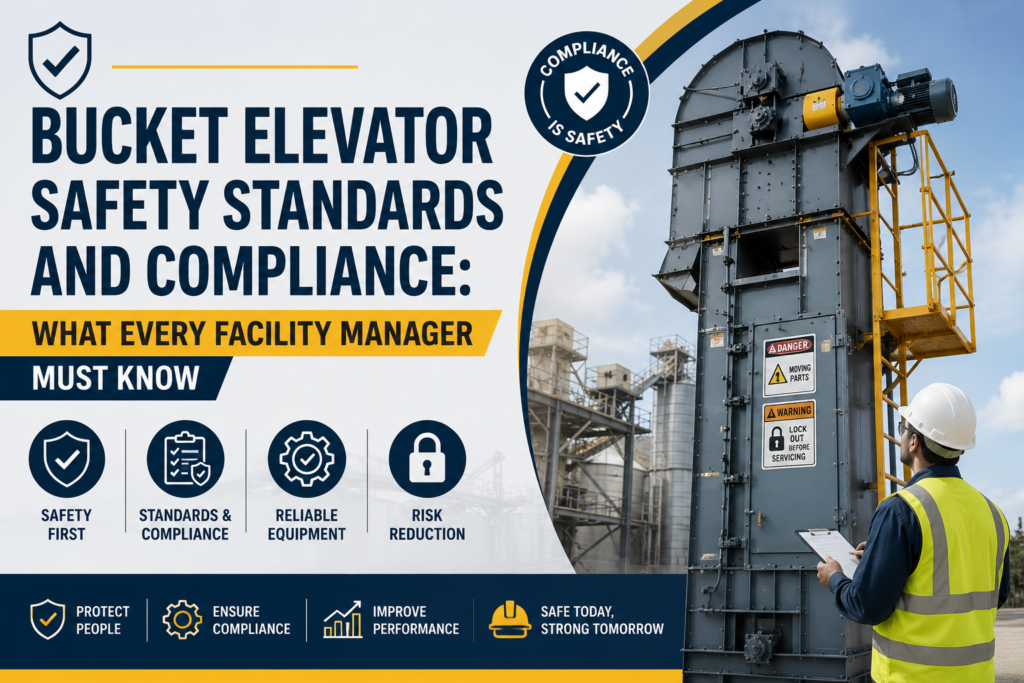
Why Bucket Elevator Safety Deserves Its Own Conversation
Bucket elevators move bulk materials vertically using a continuous belt or chain fitted with buckets. Because they operate in enclosed casings and often handle combustible dust (grain, flour, sugar, plastic pellets, coal fines), they sit at the intersection of two major hazard categories: mechanical injury risk and dust explosion risk.
A poorly maintained or non-compliant elevator can lead to:
- Belt or chain failure causing sudden equipment drop and structural damage
- Dust accumulation leading to combustible dust explosions (a leading cause of grain facility fires)
- Bearing overheating that ignites surrounding material
- Pinch-point injuries during maintenance or cleaning
- Regulatory shutdowns following OSHA or insurance inspections
Most facility managers inherit elevators that were installed years, sometimes decades, ago. The compliance landscape has shifted significantly since then, which means even equipment that was “compliant on day one” may now fall short of current expectations.
The Core Standards Facility Managers Should Know
While exact requirements vary by country, industry, and the material being handled, a few standards consistently come up in audits and inspections.
OSHA General Industry Standards (29 CFR 1910) cover machine guarding, lockout/tagout procedures, electrical safety, and confined space entry — all directly relevant to bucket elevator maintenance and operation.
NFPA 61 and NFPA 91 address fire and dust explosion prevention in agricultural and food processing facilities, including requirements for explosion venting, dust collection, and housekeeping around bulk handling equipment.
ASME B20.1 is the safety standard specifically written for conveyors and related equipment, including bucket elevators. It outlines guarding requirements, emergency stop placement, and design considerations that manufacturers and facility operators should both be familiar with.
Local fire codes and insurance underwriting guidelines often go beyond federal standards, especially for facilities storing combustible materials. Insurance carriers frequently require explosion relief panels, spark detection systems, and documented inspection schedules as a condition of coverage.
The practical takeaway: compliance isn’t a single document you check off. It’s an overlapping set of requirements from OSHA, NFPA, ASME, and your insurer — and gaps usually show up at the intersection of these standards rather than within any single one.
Where Compliance Often Breaks Down
Through routine audits, a few recurring issues show up across industries:
Inadequate guarding around moving parts. Belt and chain elevators have multiple pinch points — at the head and boot pulleys, at takeup mechanisms, and along the casing access doors. Missing or modified guards are one of the most common citations.
Lack of speed and bearing monitoring. Modern elevators should have sensors that detect belt slip, misalignment, or bearing overheating before they become ignition sources. Older installations frequently lack this entirely.
Poor housekeeping around the elevator boot and head sections. Dust accumulation on and around the casing is a primary fuel source in combustible dust incidents. This is often a housekeeping issue rather than a design issue, but inspectors treat it as a compliance failure regardless.
Outdated lockout/tagout procedures. As equipment gets modified or replaced over the years, LOTO documentation often doesn’t get updated to match, leaving gaps between what’s written and what’s actually installed.
Belt or chain condition not matching load requirements. This is where equipment selection becomes a safety issue, not just a performance one.
Why Equipment Selection Is a Safety Decision, Not Just a Performance One
This is the part facility managers sometimes overlook: the safety performance of a bucket elevator starts at the design and manufacturing stage, long before it reaches your floor.
When sourcing new equipment or replacement parts, working with reputable bucket elevator manufacturers matters because the build quality directly affects how the system behaves under stress — belt tracking, bearing tolerances, casing seal integrity, and how well the unit accommodates safety add-ons like explosion vents and speed sensors. A unit built to tighter tolerances with proper material specifications is inherently less prone to the misalignment and overheating issues that lead to incidents.
The same logic applies to the conveying components themselves. Bucket conveyor belt manufacturers that produce belts rated for the specific abrasion, temperature, and chemical exposure of your material will hold up longer and fail more predictably (with visible wear rather than sudden rupture) compared to generic, undersized belting.
For facilities running mixed material handling systems, drag chain conveyor suppliers play a similar role for horizontal and inclined transfer points feeding into or out of the elevator. Chain wear, sprocket alignment, and tensioning all affect how smoothly material transitions between conveying systems — and a poorly matched transfer point is a common source of spillage, jams, and the manual interventions that lead to injuries.
If your facility also uses screw conveyor systems for metering or distributing material before or after the elevator stage, the same compliance principles apply: proper guarding on inlet and outlet points, shaft seal integrity to prevent dust escape, and load ratings matched to actual throughput rather than theoretical maximums.
The common thread across all of these is that safety compliance is easier to maintain when the underlying equipment was specified correctly in the first place. Retrofitting safety features onto undersized or poorly matched equipment is possible, but it’s almost always more expensive and less effective than starting with the right specification.
Building a Practical Compliance Routine
Rather than treating compliance as an annual scramble before an audit, the facilities that stay consistently compliant tend to follow a similar rhythm.
Daily or shift-based checks focus on obvious red flags: unusual noise, visible dust leakage from casing seams, belt tracking issues visible through inspection ports, and temperature at accessible bearing points.
Monthly inspections go deeper — checking guard integrity, testing emergency stops, verifying that speed and bearing sensors (if installed) are reporting correctly, and reviewing housekeeping around the boot and head sections.
Annual reviews are where facility managers should bring in outside expertise — whether that’s an insurance loss-control inspection, a third-party safety audit, or a consultation with the original equipment manufacturer about whether the unit still matches current load and material conditions.
Documentation matters as much as the inspection itself. Inspectors and insurers want to see a paper trail showing that issues were identified and addressed, not just that an inspection happened. A verbal “looks fine” carries no weight; a dated checklist with corrective actions does.
Working With Manufacturers Beyond the Initial Purchase
One shift worth making is treating equipment manufacturers as ongoing partners rather than one-time vendors. Established bucket elevator manufacturers often maintain documentation on safe operating parameters, recommended inspection intervals, and retrofit options for older units that were built before current dust collection or sensor standards became common.
This is particularly useful when a facility expands or changes the material it handles. A bucket elevator originally specified for free-flowing grain, for example, will behave very differently with a denser or more abrasive material — and the belt, bucket spacing, and drive sizing may all need to be reassessed. Manufacturers who understand both the equipment and the relevant safety standards can flag these mismatches before they become compliance problems.
A Final Note on Risk and Responsibility
Bucket elevator safety isn’t glamorous, and it rarely gets attention until something goes wrong. But the facilities that avoid incidents tend to share a few habits: they treat housekeeping as a safety function, not just a cleanliness one; they keep documentation current rather than reconstructing it after the fact; and they work with manufacturers and suppliers who understand the safety standards their equipment needs to meet, not just the throughput numbers.
For facility managers, the goal isn’t perfection on day one. It’s building a routine where small issues get caught and corrected before they become the kind of finding that shows up in an incident report — or worse, an OSHA citation.