
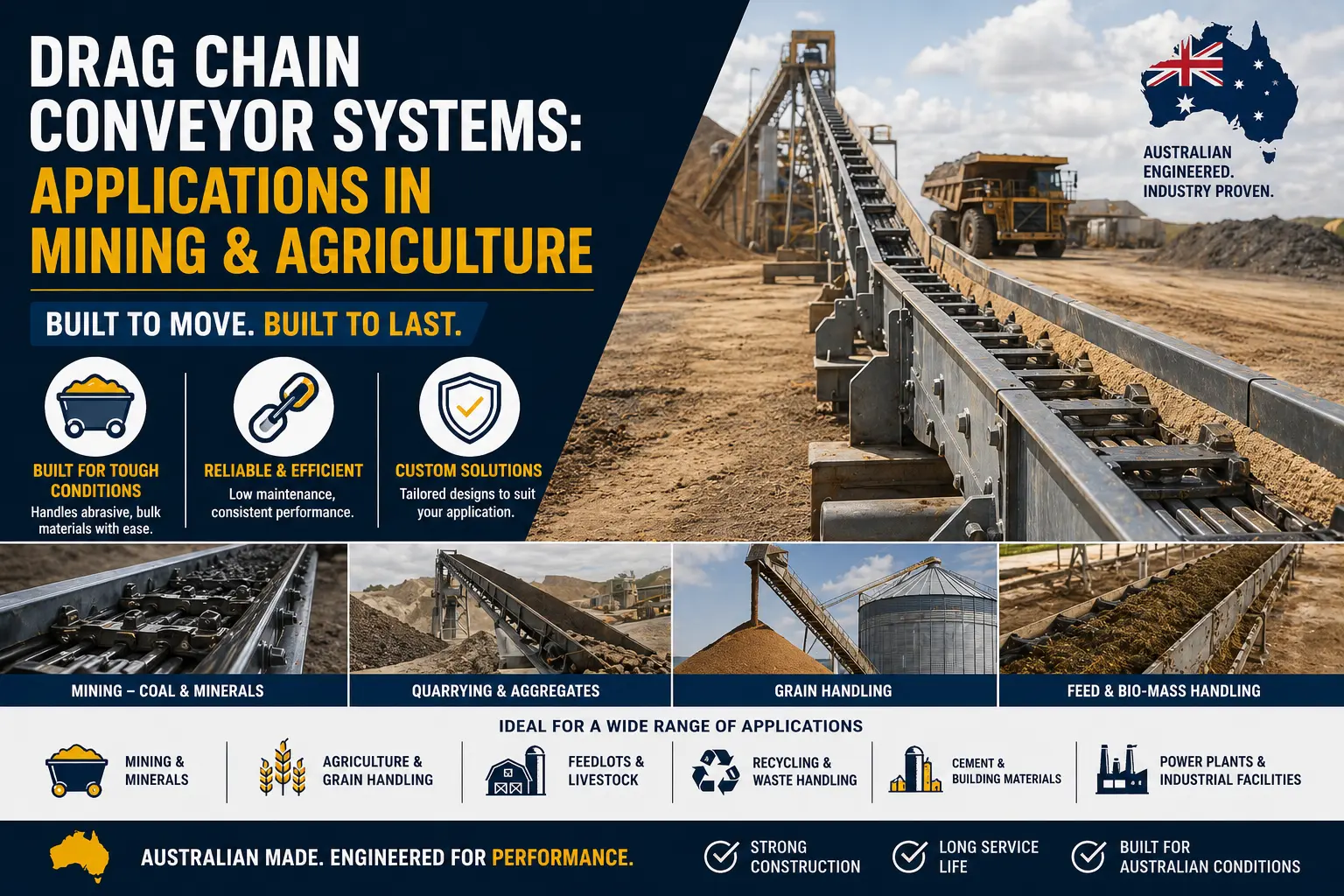
Drag Chain Conveyor Systems: Applications in Mining & Agriculture
Introduction
When bulk materials need to be moved reliably through demanding industrial environments — through dust, heat, moisture, and abrasive conditions — few systems match the durability and versatility of drag chain conveyor systems. Used extensively across Australia’s mining and agricultural sectors, these robust conveyors have become the equipment of choice for operations that cannot afford unreliable material flow.
Whether you are managing ore processing at a remote mine site, handling grain at a busy receival terminal, or moving fertilizer through an agricultural supply chain, understanding how drag chain conveyor systems work, where they excel, and how to choose the right drag chain conveyor suppliers is essential to making a sound capital investment.
This guide covers the fundamentals of drag chain conveyor systems, their core applications in mining and agriculture, key selection criteria, and what to look for when evaluating drag chain conveyor suppliers in today’s market.
What Are Drag Chain Conveyor Systems?
Drag chain conveyor systems are heavy-duty bulk material handling systems that use one or more endless chains fitted with flights, paddles, or crossbars to drag material along an enclosed trough or casing. Unlike belt conveyors, which carry material on top of a moving surface, drag chain conveyors pull material through an enclosed housing — making them particularly effective for fine, dusty, abrasive, or hazardous materials that cannot be exposed to the open environment.
The basic components of a drag chain conveyor system include:
Drive unit — Motor and gearbox assembly powering the chain
Endless chain — Single or double-strand chains running the length of the conveyor
Flights or paddles — Attached to the chain to push or drag material forward
Enclosed trough or casing — Houses the chain and material, preventing dust escape
Inlet and discharge points — Multiple inlets and outlets can be configured along the conveyor length
Take-up unit — Maintains correct chain tension throughout operation
The enclosed design of drag chain conveyor systems makes them ideal for dust-sensitive, environmentally regulated, or hazardous material handling — a growing requirement across both Australian mining and agricultural operations.
Types of Drag Chain Conveyor Systems
Reputable drag chain conveyor suppliers offer several system configurations, each suited to different material characteristics and throughput requirements.
1. En Masse Drag Chain Conveyors
En masse conveyors move material in a continuous, dense mass through the conveyor casing rather than in individual batches. The chain and flights occupy only a fraction of the cross-sectional area, while the bulk of the space is filled with material. This design maximises throughput while minimising chain wear and power consumption.
Best for: Grain, flour, malt, sugar, fine minerals, and other free-flowing bulk materials requiring high-capacity enclosed conveying.
2. Scraper Drag Chain Conveyors
Scraper conveyors use flights or scrapers attached to the chain to physically push material along the bottom of the trough. They are simpler in design than en masse systems and well-suited to heavier, coarser materials.
Best for: Coal, ore fines, aggregates, ash, and other heavy or abrasive bulk materials in mining and power generation.
3. Apron or Pan Drag Conveyors
Apron conveyors use overlapping steel pans or plates attached to chains to carry heavy, sharp, or hot materials. They are among the most rugged drag conveyor designs available and are commonly used in primary crushing and ore handling applications.
Best for: Run-of-mine ore, crushed rock, hot clinker, and heavy mining materials requiring gentle, low-impact conveying.
4. Tubular Drag Chain Conveyors
Tubular drag chain conveyors move material through a completely enclosed circular tube using a cable or chain with discs attached at intervals. The fully sealed design makes them ideal for hygienic, dust-free, or multi-directional conveying in food-grade and pharmaceutical environments.
Best for: Food ingredients, pharmaceutical powders, and fine agricultural products requiring hygienic, sealed conveying.
5. Heavy-Duty Mining Drag Conveyors
Purpose-built for the harshest Australian mining environments, these systems feature hardened chain components, wear-resistant trough liners, and high-torque drive systems. Leading drag chain conveyor suppliers engineer these systems to handle continuous operation in extreme heat, dust, and abrasive material conditions.
Best for: Underground coal mining, ore processing, tailings handling, and mineral processing plants.
Applications in Mining
Australia’s mining sector — one of the largest in the world — relies heavily on drag chain conveyor systems for a wide range of material handling tasks. The enclosed, robust nature of these systems makes them particularly well-suited to the demanding conditions found at Australian mine sites.
Drag chain conveyors, particularly scraper and armoured face conveyor (AFC) variants, are the primary means of moving coal from the longwall or continuous miner face to the main gate conveyor. Their ability to operate in confined underground spaces, handle irregular lump sizes, and withstand the harsh underground environment makes them indispensable in Australian coal operations in Queensland and New South Wales.
At surface processing plants, drag chain conveyor systems move crushed ore, concentrates, and mineral fines between processing stages — from primary crushing through to flotation, leaching, and final product handling. The enclosed design prevents dust emissions and material loss, critical for both environmental compliance and product recovery in high-value mineral operations.
Power stations and processing plants generate large volumes of fly ash, bottom ash, and tailings that must be removed continuously. Drag chain conveyor systems handle these difficult materials reliably, moving wet, abrasive, or chemically aggressive residues without the spillage and dust issues associated with open belt systems.
Drag chain conveyor systems are used at mine site stockpile reclaim tunnels, and transfer stations where material must be moved from under a stockpile to a main conveyor or process feed point. Their ability to handle variable feed rates and start under load makes them ideal for reclaim applications.
When selecting drag chain conveyor suppliers for mining applications, prioritise those with demonstrated experience in Australian mining environments, hardened chain and liner options, and rapid spare parts availability to remote sites.
Applications in Agriculture
Australia’s agricultural sector — a major global exporter of grain, fertilizer, and processed food commodities — has widely adopted drag chain conveyor systems for their gentle material handling, enclosed design, and ability to handle multiple product types in the same system.
Grain Receival and Storage
En masse drag chain conveyor systems are widely used at country grain receival depots and port terminals to move wheat, barley, canola, sorghum, and other grains from truck receival pits to storage silos and from silos to ship loaders. Their gentle conveying action minimises grain breakage and maintains grain quality — critical for meeting export grade standards.
Choosing drag chain conveyor suppliers with food-grade material options, stainless steel contact surfaces, and compliance with Australian grain handling standards ensures systems meet both operational and regulatory requirements.
Fertilizer Handling and Distribution
Fertilizer blending and distribution facilities use drag chain conveyor systems to move granular and powdered fertilizers — including urea, DAP, MAP, and potash — through enclosed systems that prevent moisture absorption, dust generation, and product contamination. The corrosive nature of many fertilizer products requires drag chain conveyor suppliers to offer corrosion-resistant chain and liner materials.
Malt and Brewing
Malthouses and breweries across Australia use en masse drag chain conveyors to move malted barley through soaking, germination, kilning, and storage stages. The gentle en masse conveying action preserves malt kernel integrity while the enclosed design maintains the hygienic conditions required for food-grade processing.
Animal Feed and Pelleting
Feed mills producing poultry, livestock, and aquaculture feed use drag chain conveyor systems to move raw ingredients, mixed mash, and finished pellets through the production process. Multiple inlet and outlet points on a single drag chain conveyor system allow flexible routing of different products through the same facility.
Cotton Gin and Fibre Handling
In Australia’s cotton-growing regions of Queensland and New South Wales, drag chain conveyors move seed cotton and lint through gin processing facilities. The gentle, low-speed conveying action of en masse systems prevents fibre damage and maintains cotton grade quality through the ginning process.
Key Advantages of Drag Chain Conveyor Systems
Understanding why industries choose drag chain conveyor systems over alternative conveying technologies helps clarify the investment case:
Fully enclosed operation — Eliminates dust, spillage, and environmental contamination
Multiple inlet and outlet points — One system can serve multiple feed and discharge locations simultaneously
Start under load — Systems can restart with a full load of material, critical for operations with frequent start-stop cycles
Gentle material handling — En masse designs move material with minimal degradation, preserving product quality
Compact footprint — High conveying capacity relative to physical size
Handles multiple materials — The same system can convey different products at different times with simple cleaning between runs
Low maintenance — Fewer moving parts than complex conveying systems reduce maintenance burden and cost
How to Choose the Right Drag Chain Conveyor Suppliers
Selecting the right drag chain conveyor suppliers is as important as selecting the right system type. Consider the following criteria carefully:
Engineering Capability
Look for suppliers with in-house engineering teams who can design custom systems to your exact material, throughput, and site requirements — not just standard off-the-shelf configurations.
Material and Application Experience
The best drag chain conveyor suppliers have proven experience with your specific material and industry. Request references from comparable Australian mining or agricultural installations before committing.
Local Support and Spare Parts
For operations in remote Australian locations, local technical support and fast spare parts supply are non-negotiable. Confirm that your supplier maintains Australian spare parts stock and can provide on-site service when needed.
Chain and Liner Quality
The chain and trough liner are the highest-wear components in any drag chain conveyor system. Leading suppliers offer hardened chain options, replaceable wear liners, and hardfacing on high-wear contact surfaces to extend service intervals.
Compliance and Safety
Ensure systems are designed and manufactured to comply with Safe Work Australia guidelines and relevant Australian standards, including AS 4024 machinery safety requirements.
Total Cost of Ownership
Evaluate suppliers on total cost of ownership — not just purchase price. A higher-quality system from an experienced supplier will typically deliver lower maintenance costs, longer service life, and higher uptime over its operational life.
Conclusion
Drag chain conveyor systems have earned their place as one of the most reliable and versatile bulk material handling solutions across the Australian mining and agricultural industries. Their enclosed design, gentle handling capability, flexibility in configuration, and proven durability in harsh operating conditions make them a compelling choice for operations where material quality, environmental compliance, and system uptime are paramount.
Whether you are handling coal underground, elevating grain at a port terminal, or moving fertilizer through a blending facility, choosing the right system design and partnering with experienced drag chain conveyor suppliers will determine whether your investment delivers long-term operational value or becomes a source of ongoing maintenance headaches.
Take time to evaluate your material characteristics, throughput requirements, and site conditions thoroughly — and work with drag chain conveyor suppliers who have the engineering capability, Australian industry experience, and local support infrastructure to back up their systems for the long term.