
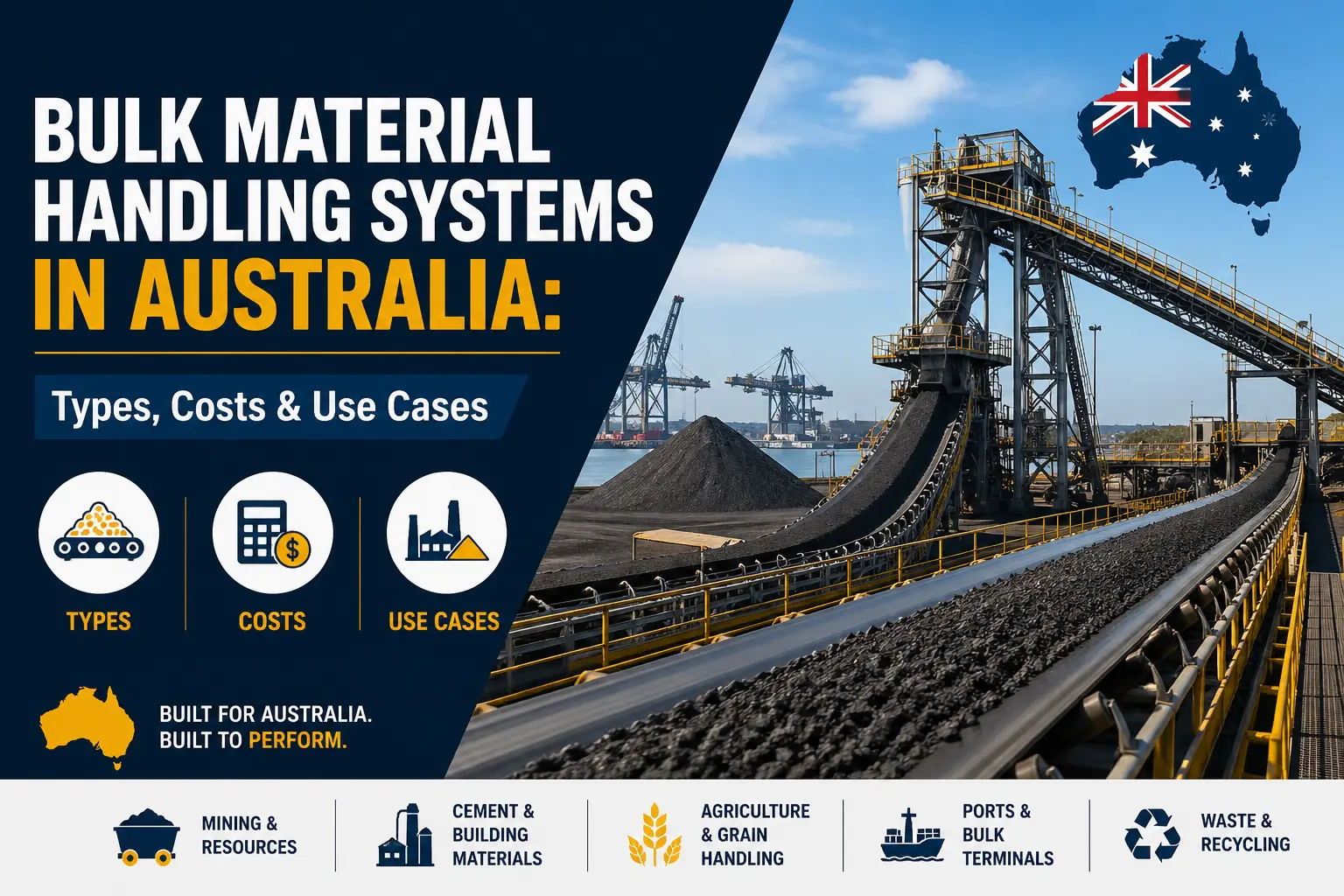
Bulk Material Handling Systems in Australia: Types, Costs & Use Cases
Introduction
Australia’s industrial economy runs on bulk materials — iron ore from the Pilbara, grain from Queensland, coal from New South Wales, and chemicals from Victoria’s manufacturing corridors. Moving these materials safely, efficiently, and at scale requires one thing above all else: a reliable bulk material handling system.
Yet many businesses struggle to choose the right solution, understand realistic costs, or identify the right conveyor belt suppliers and bucket conveyor belt manufacturers for their specific needs.
This guide breaks down everything you need to know — types of systems, cost estimates, key use cases, and how to make the right choice for your Australian operation.
What Are Bulk Material Handling Systems?
Bulk material handling systems are integrated mechanical and automated systems designed to move, store, and process large volumes of loose materials — minerals, grains, powders, coal, sand, and chemicals — with minimal manual intervention.
In Australia, these systems are deployed across mining, agriculture, construction, ports, food processing, and chemical manufacturing. The right system, paired with quality components from trusted conveyor belt suppliers, directly determines operational efficiency, safety outcomes, and long-term profitability.
Why It Matters in Australia
Australia’s unique industrial landscape makes bulk material handling more important than in most countries:
World-leading export volumes — Australia is the largest exporter of iron ore globally and a top-five coal and grain exporter
Vast distances — Materials must often travel hundreds of kilometres from mine or farm to port
High labour costs — Automation through handling systems delivers a strong ROI compared to manual alternatives
Strict regulations — Safe Work Australia guidelines and AS standards demand engineered, compliant solutions
Remote site challenges — Systems must operate reliably in extreme heat, dust, and isolation
Types of Bulk Material Handling Systems in Australia
1. Belt Conveyor Systems
Belt conveyors are the most widely used bulk handling solution in Australia. They move materials continuously across short or long distances and are the backbone of mining, port, and grain handling operations.
Common applications include iron ore transport at Pilbara mine sites, coal movement at Queensland export terminals, and grain conveying at receival facilities. Choosing the right conveyor belt suppliers is critical — belt quality affects load capacity, abrasion resistance, splice integrity, and overall system lifespan.
When evaluating suppliers, look for local warehousing, mining-grade product certification, fast delivery to remote sites, and on-site splicing support.
Best for: Mining, ports, quarrying, grain handling
2. Bucket Conveyor Systems
Bucket conveyors are designed for vertical or steep-incline elevation of bulk materials. They are widely used in grain terminals, cement plants, fertilizer facilities, and mining ore processing operations across Australia.
The performance of a bucket conveyor system depends heavily on the belt. Working with experienced bucket conveyor belt manufacturers ensures you get belting with the right tensile strength, bucket attachment compatibility, and resistance to the specific material being elevated — whether that’s abrasive ore, hygroscopic grain, or corrosive chemicals.
Types commonly used in Australia:
Centrifugal Discharge Elevators — High-speed grain and sand elevation
Continuous Bucket Elevators — Gentle handling of fragile or aerated materials
Positive Discharge Elevators — For sticky or difficult-to-convey materials
When sourcing from bucket conveyor belt manufacturers, always request Australian installation references, check belt certification documentation, and confirm spare parts lead times to avoid costly downtime.
Best for: Grain terminals, cement plants, fertilizer handling, food processing
3. Pneumatic Conveying Systems
Pneumatic systems use air pressure or vacuum to move fine powders and granules through enclosed pipelines. They are increasingly popular in Australia due to their dust-free operation, hygienic properties, and suitability for food and pharmaceutical environments.
Dilute Phase — High-velocity transport for light, non-abrasive materials like flour and sugar
Dense Phase — Low-velocity, high-pressure transport for abrasive or fragile materials like cement and fly ash
Best for: Food processing, pharmaceuticals, cement, plastics manufacturing
4. Stackers and Reclaimers
These large machines manage bulk stockpiles at Australian mine sites and port terminals. Stackers build stockpiles of iron ore, coal, or bauxite, while reclaimers retrieve material and feed it into the loading or processing chain. Combined stacker-reclaimers reduce capital expenditure by handling both functions in a single machine.
These systems rely on heavy-duty conveyor belting. Partnering with established conveyor belt suppliers who stock port and mining-grade belts ensures maximum uptime in critical operations.
Best for: Iron ore and coal mines, port export terminals, alumina refineries
5. Silos, Feeders & Weighing Systems
Rounding out the bulk handling ecosystem are storage, feeding, and measurement systems:
Silos and Hoppers — Steel or concrete storage for grain, cement, and minerals
Belt and Screw Feeders — Control material flow rate into processing or conveying systems
Belt Scales and Weigh Feeders — Monitor throughput and ensure accurate batching for compliance and inventory management
These components work in conjunction with conveyor and elevator systems, and their reliability depends on the quality of all upstream components — including belting sourced from reputable conveyor belt suppliers.
Best for: Grain storage, cement batching, chemical processing, export terminals
Cost of Bulk Material Handling Systems in Australia
Costs vary widely depending on system type, capacity, material characteristics, automation level, and site location. Below is a realistic cost guide for the Australian market:
Material type — Abrasive, corrosive, or hazardous materials require specialised components and higher-grade belting from certified bucket conveyor belt manufacturers
Throughput capacity — Higher tonnes-per-hour requirements significantly increase system size and cost
Automation level — PLC and SCADA-integrated systems cost more upfront but reduce ongoing labour costs substantially
Site remoteness — Remote WA or NT installations add logistics, installation, and commissioning costs
Compliance — Meeting AS 1755 and AS 4024 standards adds engineering and certification expenses
Maintenance contracts — Typically add 5–15% of capital cost annually
Common Use Cases Across Australian Industries
Australia’s mining sector is the largest consumer of bulk material handling systems. Belt conveyors move iron ore at Pilbara operations run by BHP, Rio Tinto, and Fortescue. Bucket elevators process gold and copper ore in Queensland and South Australia. The fast-growing lithium and critical minerals sector is creating new demand for specialist handling solutions and bucket conveyor belt manufacturers with experience in battery material processing.
Australia exports over 30 million tonnes of grain annually. Bucket conveyor systems are central to receival terminals, port loading facilities, and on-farm storage setups. Grain-contact belting must meet Australian food safety standards — a factor to confirm with your chosen conveyor belt suppliers before procurement.
Major ports at Newcastle, Port Hedland, Fremantle, and Gladstone handle tens of millions of tonnes of bulk cargo each year. Ship loaders, unloaders, and stockyard systems all depend on heavy-duty belting. Trusted conveyor belt suppliers with 24/7 emergency supply capability are essential partners for port operations where downtime is measured in millions of dollars per hour.
Food processors rely on pneumatic and bucket conveyor systems for hygienic powder and ingredient handling. Chemical plants use enclosed conveying for safe movement of hazardous materials. Construction and quarrying operations use belt conveyors and screening systems for aggregate, sand, and recycled material processing.
How to Choose the Right System and Supplier
Understand your material’s particle size, density, moisture content, abrasiveness, and flow characteristics before selecting a system type. A material that flows freely may suit a belt or pneumatic system, while sticky or cohesive materials may require specialised feeders or positive-discharge bucket elevators.
Always design for growth. Upgrading a system mid-operation is far more expensive than specifying additional capacity upfront. Work with your engineering partner to model projected throughput over a 10–15 year horizon.
The belt is often the most failure-prone component in any bulk handling system. When evaluating conveyor belt suppliers and bucket conveyor belt manufacturers, confirm:
Local Australian presence with warehoused stock
Product certification to Australian and international standards
Ability to deliver to remote sites with short lead times
On-site splicing, installation, and maintenance services
References from comparable Australian operations in your industry
All systems must comply with Safe Work Australia guidelines, AS 1755 conveyor safety standards, and AS 4024 machinery safety requirements. State-based WorkSafe and environmental regulations also apply, particularly for dust generation and noise emissions.
Conclusion
Bulk material handling systems are fundamental to Australia’s industrial output — from mine to port, farm to export terminal, and factory to distribution centre. Choosing the right system type, understanding realistic costs, and partnering with experienced conveyor belt suppliers and bucket conveyor belt manufacturers are the three pillars of a successful bulk handling investment.
Whether you’re upgrading an ageing conveyor at a grain terminal or designing a greenfield handling system for a new mine, taking a structured approach — matching system type to material, planning for capacity growth, and vetting suppliers thoroughly — will deliver long-term operational and financial returns.