
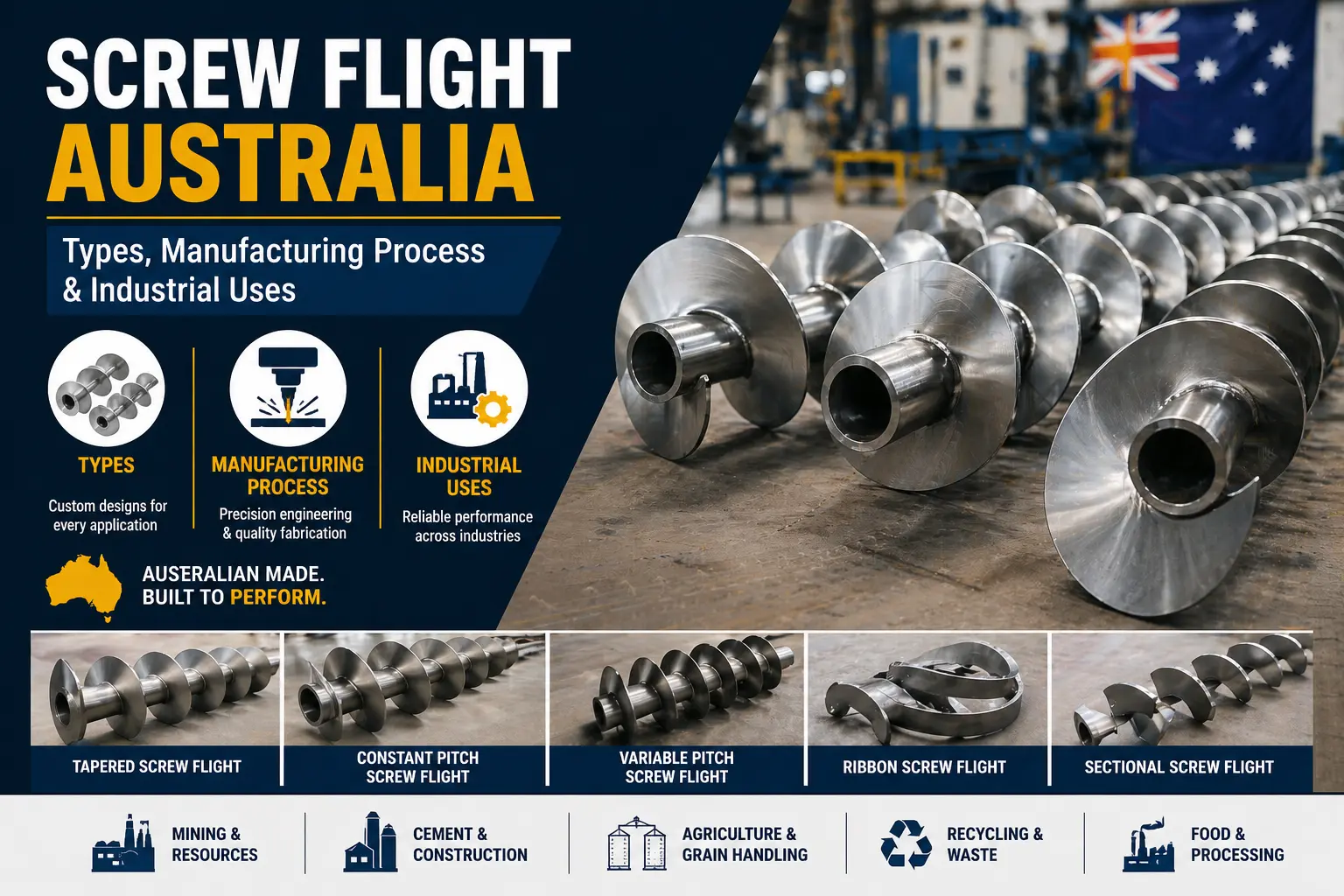
Screw Flight Australia: Types, Manufacturing Process & Industrial Uses
Introduction
In industries where bulk materials must be moved efficiently through enclosed or semi-enclosed systems, the screw flight is one of the hardest-working yet underappreciated components in the entire operation. From grain-handling terminals in South Australia to mining processing plants in Western Australia and chemical facilities in Queensland, Screw Flight Australia has become a critical focus for engineers, procurement teams, and plant managers alike.
A screw flight — the helical blade wrapped around a central shaft — is what drives material forward inside a screw conveyor. Without the right flight design, material jams, system inefficiencies, and costly downtime become inevitable. Choosing the right screw flight manufacturers and understanding the types, manufacturing process, and industrial applications available in Australia is essential for any business that relies on bulk material conveying.
This guide covers everything you need to know about screw flights in the Australian industrial context — from types and materials to manufacturing processes, industry applications, and what to look for when selecting screw conveyor flight manufacturers for your operation.
What Is a Screw Flight?
A screw flight is a helical-shaped blade or ribbon manufactured from steel or other metals and wound around a central pipe or shaft to form a screw conveyor. When the shaft rotates, the flight pushes bulk material along the conveyor’s length — similar in principle to how a wood screw drives into timber.
Screw flights are the core functional element of screw conveyors, which are among the most widely used bulk material handling systems globally and across Australian industries. The geometry, pitch, thickness, and material of the flight determine how effectively and gently the material is conveyed, making flight selection a critical engineering decision.
Why Screw Flights Matter in the Australian Industry
Australia’s heavy reliance on bulk material handling — across mining, agriculture, food processing, construction, and chemical manufacturing — makes screw flight quality and precision especially important.
Key reasons for screw flights are critical in the Australian context include:
Harsh operating conditions — Extreme heat, dust, and corrosive environments in Australian mine sites and processing plants demand high-grade flight materials and coatings
High throughput demands — Australia’s export-driven industries require conveyors that operate continuously at high capacity without failure
Material diversity — Australian facilities handle everything from fine powders and grain to abrasive ores and wet sludge, each requiring different flight designs
Remote locations — Mine and agricultural sites far from major cities require durable flights with long service life to minimise replacement frequency
Cost of downtime — In high-value operations, every hour of unplanned downtime translates into significant financial loss, making flight quality non-negotiable
Working with experienced screw flight manufacturers who understand Australia’s unique industrial demands ensures systems are built for longevity and performance from day one.
Types of Screw Flights
Understanding the different types of screw flights is essential for selecting the right solution. Reputable screw conveyor flight manufacturers in Australia offer a range of flight types, each engineered for specific material characteristics and conveying requirements.
1. Standard Helicoid Flights
The most common flight type, helicoid flights are formed from a flat strip of steel rolled into a continuous helix. They offer a smooth, consistent pitch and are suitable for free-flowing, non-abrasive materials.
Best for: Grain, flour, sugar, plastic pellets, light powders
2. Sectional Flights
Sectional flights are manufactured as individual helix sections that are welded together onto the shaft. They allow for greater flexibility in pitch and diameter customisation and are easier to replace in sections when worn.
Best for: Heavy-duty applications, abrasive materials, custom conveyor configurations
3. Ribbon Flights
Ribbon flights feature an open helix design — a continuous strip wound in a spiral with a gap between the flight and the central shaft. This open design prevents material from packing around the shaft and is ideal for sticky, viscous, or fibrous materials.
Best for: Wet sludge, clay, adhesive chemicals, fibrous agricultural waste
4. Paddle Flights
Paddle flights incorporate flat or angled paddles attached to the shaft at intervals, rather than a continuous helix. They are used where mixing, agitation, or blending of material is required in addition to conveying.
Best for: Mixing applications in food processing, chemical blending, and composting facilities
5. Cut and Folded Flights
These flights have sections cut out and folded at angles along the helix. The cuts create a tumbling action as material moves along the conveyor, promoting mixing and aeration.
Best for: Materials requiring aeration or gentle agitation, fertiliser blending, grain conditioning
6. Tapered Flights
Tapered flights gradually increase in pitch or diameter along the conveyor length. They are used where material needs to be compacted or where intake volume needs to be controlled to avoid overloading.
Best for: Compaction applications, extruder feed systems, intake control in processing plants
7. Hardened and Wear-Resistant Flights
For highly abrasive materials such as mining ore, sand, and clinker, screw conveyor flight manufacturers offer flights manufactured from hardened steel alloys or fitted with wear-resistant overlays such as tungsten carbide or chromium carbide hardfacing.
Best for: Mining ore processing, cement, aggregate handling, abrasive mineral conveying
Manufacturing Process of Screw Flights in Australia
Understanding how screw flights are manufactured helps procurement and engineering teams evaluate quality, lead times, and supplier capability. Leading screw flight manufacturers in Australia use a combination of traditional metal forming and modern CNC technology.
The process begins with selecting the appropriate base material. Common materials used by Australian screw flight manufacturers include:
Mild steel (AS/NZS 3678) — Standard applications with moderate loads
Stainless steel (304 / 316) — Food processing, pharmaceutical, and corrosive environments
Hardox and AR400 wear plate — Abrasive mining and aggregate applications
Duplex stainless steel — High-corrosion environments, including chemical and marine applications
Steel blanks are cut into annular (donut-shaped) rings using laser cutting, plasma cutting, or waterjet cutting. The inner and outer diameters of the blank determine the pitch and diameter of the finished flight.
Precision cutting is critical — dimensional accuracy at this stage directly affects the flight’s helix consistency and conveying performance. Quality screw conveyor flight manufacturers use CNC laser or plasma cutters to maintain tight tolerances.
Each annular blank is pressed through a forming die to open the inner hole and create the helical shape. This cold-forming process work-hardens the steel, improving its strength and wear resistance without the need for additional heat treatment in standard grades.
For thicker or harder materials such as Hardox, hot pressing or specialised tooling is required. Experienced screw flight manufacturers invest in heavy-duty pressing equipment to handle the full range of material grades used in the Australian industry.
Individual flight sections are welded together and onto the central shaft or pipe. Weld quality is paramount — poor welds are the most common cause of flight failure in service. Reputable screw conveyor flight manufacturers use qualified welders and follow Australian welding standards (AS/NZS 1554) to ensure full-penetration, defect-free welds throughout.
Depending on the application, finished flights may receive:
Shot blasting and painting — Corrosion protection for outdoor or humid environments
Hot-dip galvanising — Long-term corrosion resistance for agricultural and coastal applications
Hardfacing overlay — Tungsten carbide or chromium carbide applied to flight edges for maximum abrasion resistance in mining applications
Electropolishing — Smooth, hygienic finish for food-grade and pharmaceutical applications
Before dispatch, reputable screw flight manufacturers conduct dimensional checks, weld inspection, and surface quality verification. For critical applications, non-destructive testing (NDT) methods such as magnetic particle inspection or dye penetrant testing may be applied to verify weld integrity.
Industrial Uses of Screw Flights in Australia
Mining and Mineral Processing
Screw conveyors fitted with hardened flights are used to move ore, tailings, and mineral concentrates through processing plants. The abrasive nature of these materials demands flights sourced from specialist screw conveyor flight manufacturers with hardfacing capability.
Agriculture and Grain Handling
Screw conveyors are the workhorses of Australian grain handling — moving wheat, barley, canola, and sorghum at receival depots, silos, and port terminals. Stainless or food-grade mild steel flights from certified screw flight manufacturers are essential for grain-contact applications.
Food and Beverage Processing
In flour mills, breweries, sugar refineries, and dairy processing plants, screw flights must meet strict hygiene standards. Stainless steel ribbon or standard flights from food-certified screw conveyor flight manufacturers ensure product safety and compliance with Australian food standards.
Wastewater and Sludge Handling
Ribbon flights are widely used in Australian wastewater treatment facilities to convey wet sludge, screenings, and biosolids. Corrosion-resistant materials and quality welds are non-negotiable in these environments.
Chemical and Pharmaceutical Manufacturing
Enclosed screw conveyors with precision-manufactured flights handle hazardous powders, chemical compounds, and pharmaceutical ingredients safely. Screw flight manufacturers supplying this sector must demonstrate GMP compliance and material traceability.
Construction and Cement
Cut and folded or standard helicoid flights are used in cement batching plants, concrete mixing facilities, and aggregate processing operations across Australia.
Choosing the Right Screw Flight Manufacturers in Australia
When selecting screw flight manufacturers or screw conveyor flight manufacturers for your Australian operation, evaluate the following:
Local manufacturing capability — Australian-made flights mean faster lead times and easier quality verification
Material range — Can the manufacturer supply mild steel, stainless, and hardened grades?
Custom design capability — Can they engineer non-standard pitches, diameters, and flight profiles to your specification?
Welding certifications — Confirm compliance with AS/NZS 1554 welding standards
Industry references — Request examples from comparable Australian operations in your sector
After-sales support — Do they offer technical advice, installation support, and replacement part availability?
Conclusion Screw flights may be a single component within a larger bulk handling system, but their impact on operational efficiency, material throughput, and system longevity is profound. Across Screw Flight Australia’s diverse industrial landscape — from Pilbara mine sites to Queensland grain terminals and Victorian food processing plants — the right flight design and manufacturing quality make all the difference. By understanding the types of screw flights available, the manufacturing process behind them, and the industrial applications they serve, Australian businesses can make confident, well-informed decisions when partnering with screw flight manufacturers and screw conveyor flight manufacturers. Looking for precision-manufactured screw flights for your Australian operation? Partner with certified local manufacturers who understand your material, your industry, and your operating environment. FAQs’ Q1. What is a screw flight, and what does it do? A screw flight is a helical blade made of steel or other metals, wound around a central shaft or pipe to form a screw conveyor. When the shaft rotates, the flight pushes bulk material forward along the conveyor’s length. It is the core functional component of any screw conveyor system and directly determines how efficiently, gently, and consistently material is moved through the system. The right flight design ensures smooth material flow, minimal degradation, and long service life. Q2. What are the most common types of screw flights used in Australia? The most commonly used screw flight types across Australian industries include standard helicoid flights for free-flowing materials like grain and sugar, sectional flights for heavy-duty and abrasive applications, ribbon flights for sticky or viscous materials like sludge, paddle flights for mixing and blending applications, and hardened wear-resistant flights for abrasive mining and mineral processing environments. The right type depends on your material characteristics, throughput requirements, and operating conditions. Q3. What materials are screw flights manufactured from in Australia? Reputable screw flight manufacturers in Australia work with a range of materials depending on the application. Mild steel is used for standard bulk handling, stainless steel (304 or 316 grade) for food processing, pharmaceutical, and corrosive environments, Hardox and AR400 wear plate for abrasive mining applications, and duplex stainless steel for high-corrosion chemical or marine environments. The choice of material directly impacts flight longevity, hygiene compliance, and maintenance frequency. Q4. How are screw flights manufactured? The manufacturing process typically involves six key stages — material selection, blank cutting using CNC laser or plasma cutting, cold or hot press forming to create the helical shape, welding and assembly onto the central shaft, surface finishing such as painting, galvanising, or hardfacing, and final quality inspection. Leading screw conveyor flight manufacturers in Australia follow Australian welding standards (AS/NZS 1554) and conduct dimensional and weld integrity checks before dispatch to ensure every flight meets specification. Q5. How do I choose the right screw flight type for my application? Choosing the right screw flight starts with understanding your material’s properties — particle size, density, moisture content, abrasiveness, and flowability. Free-flowing dry materials suit standard helicoid flights, while sticky or fibrous materials perform better with ribbon flights. Abrasive materials such as ore or cement require hardened flights with wear-resistant overlays. Consulting with experienced screw flight manufacturers who can review your material data sheet and operating conditions is the most reliable way to make the right selection. Q6. What industries use screw flights in Australia? Screw flights are used across a wide range of Australian industries, including mining and mineral processing, grain and agricultural handling, food and beverage manufacturing, wastewater and sludge treatment, chemical and pharmaceutical production, cement and concrete batching, and construction material processing. Each industry has specific material handling requirements that influence the flight type, material grade, and surface finish required from screw conveyor flight manufacturers. Q7. How long do screw flights typically last in service? Service life varies significantly depending on the material being conveyed, the flight material and surface treatment, operating speed, and maintenance practices. In low-abrasion applications such as grain handling, well-manufactured flights can last many years with minimal wear. In high-abrasion mining or cement applications, service life may be significantly shorter without hardfacing overlays. Partnering with quality screw flight manufacturers who offer hardfacing options and precision manufacturing can extend service life considerably and reduce the total cost of ownership. Q8. Can screw flights be custom-manufactured to non-standard specifications? Yes. Reputable screw flight manufacturers in Australia offer full custom manufacturing capability, including non-standard pitches, diameters, thicknesses, and flight profiles. Custom flights are commonly required for specialised processing equipment, retrofit applications, or unique material characteristics that standard off-the-shelf flights cannot accommodate. When requesting custom flights, provide your shaft diameter, outer flight diameter, pitch, material type, and throughput requirements to help manufacturers engineer the correct solution. Q9. What should I look for when choosing screw conveyor flight manufacturers in Australia? When evaluating screw conveyor flight manufacturers, look for local Australian manufacturing capability for faster lead times, a broad material range covering mild steel, stainless, and hardened grades, custom design and engineering support, compliance with AS/NZS 1554 welding standards, proven references from comparable Australian operations in your industry, and responsive after-sales support including technical advice and replacement part availability. Choosing a manufacturer with all these qualities minimises risk and ensures consistent, long-term system performance. Q10. Are Australian-made screw flights better than imported alternatives? Australian-manufactured screw flights offer several practical advantages over imported alternatives — shorter lead times, easier quality verification, compliance with Australian standards, and local technical support. For operations in remote locations where downtime is costly, having a local manufacturer who can supply replacement flights quickly is a significant operational advantage. While imported flights may appear cost-competitive on purchase price, the total cost of ownership — factoring in lead times, quality risk, and support — often favours locally manufactured options from established Australian screw flight manufacturers.